
AI Art Theft and Small Business: A Practical Guide to Intellectual Property Risks and Safer Creative Workflows
AI image generators have put agency-level visuals within reach of every small business. But they’ve also created a fast-moving intellectual property risk zone where “good enough” sourcing can lead to takedowns, ad account suspensions, or costly disputes. This guide breaks down what “AI art theft” really means, how copyright and related rights apply, and—most importantly—how to build a responsible, repeatable workflow for marketing visuals. If you’re a founder, operations manager, or professional services leader who relies on graphics, ads, pitch decks, or client deliverables, use this playbook to protect your brand while keeping creative velocity high.
- What “AI art theft” means—and why it matters to small businesses
- Copyright, trademark, and publicity rights: How they apply to AI images
- Real-world risk scenarios for small businesses
- A 7‑Layer IP Risk Mitigation Framework for AI visuals
- Comparison table: Safer AI image sourcing options
- Procurement checklist and contract clauses to reduce risk
- 30‑60‑90 day implementation roadmap and KPIs
- Conclusion
What “AI art theft” means—and why it matters to small businesses
“AI art theft” is an umbrella term people use to describe two related issues. First, training data: some models were trained on large internet image scrapes that included copyrighted works without permission, raising moral and legal debates. Second, outputs: if your generated image is substantially similar to a protected work, mimics a living artist’s distinctive style in a way that could imply endorsement, uses someone’s trademark, or depicts a person without the right releases, you can be the one on the hook when you publish or sell it. Even when you didn’t intend to infringe, platforms, marketplaces, and clients expect you to manage risk.
For small businesses, the stakes are practical: campaigns paused due to takedown notices, client dissatisfaction or chargebacks, and reputational harm. The good news is that you can adopt sensible governance—clear sourcing rules, review checkpoints, and documentation—to capture AI’s creative upside while minimizing IP exposure.
Copyright, trademark, and publicity rights: How they apply to AI images
1) Copyright basics for visuals
Copyright protects original expression fixed in a tangible medium. In images, that’s composition, color choices, arrangement, and other creative elements. Copyright does not protect general ideas (e.g., “a blue robot in a city”) but it does protect particularized expressions of those ideas (a recognizably similar composition, props, lighting, and arrangement).
2) Who owns an AI-generated image?
- Terms-first reality: Ownership flows from the platform or model license you use. Some services grant you broad commercial rights; others restrict uses or require attribution. Read the terms every time they change.
- Human authorship matters: The law continues to evolve, but a best practice is to ensure meaningful human creative input—prompt engineering, iterative editing, compositing, and layout—so the final asset reflects human-directed authorship.
- Work-for-hire and vendor deliverables: If agencies, freelancers, or contractors generate images for you, ensure your agreement assigns all rights and warrants non-infringement.
3) Trademarks and trade dress
Including another company’s logo, iconic bottle shape, or instantly recognizable mascot in your AI images can trigger trademark or trade dress claims, especially if it suggests affiliation or endorsement. Scrub outputs for look‑alike marks and confusingly similar branding before publishing ads or product pages.
4) Right of publicity and model releases
When images depict real people or closely resemble a real person, you may need a model release—especially for ads and commercial uses. This extends to AI-generated portraits that are based on uploads you provided. If the subject is a recognizable individual (even a composite), obtain appropriate consent.
5) Fair use: Helpful but not a business strategy
Fair use is a narrow, fact‑specific defense. Building campaigns around “maybe it’s fair use” is high risk for small businesses. Prioritize clear licenses and provenance over assumptions.
Expert insight: The most common mistake small teams make is treating AI outputs like “free stock.” They are not. Every asset needs a traceable source, clear license, and a quick rights check before it goes live.
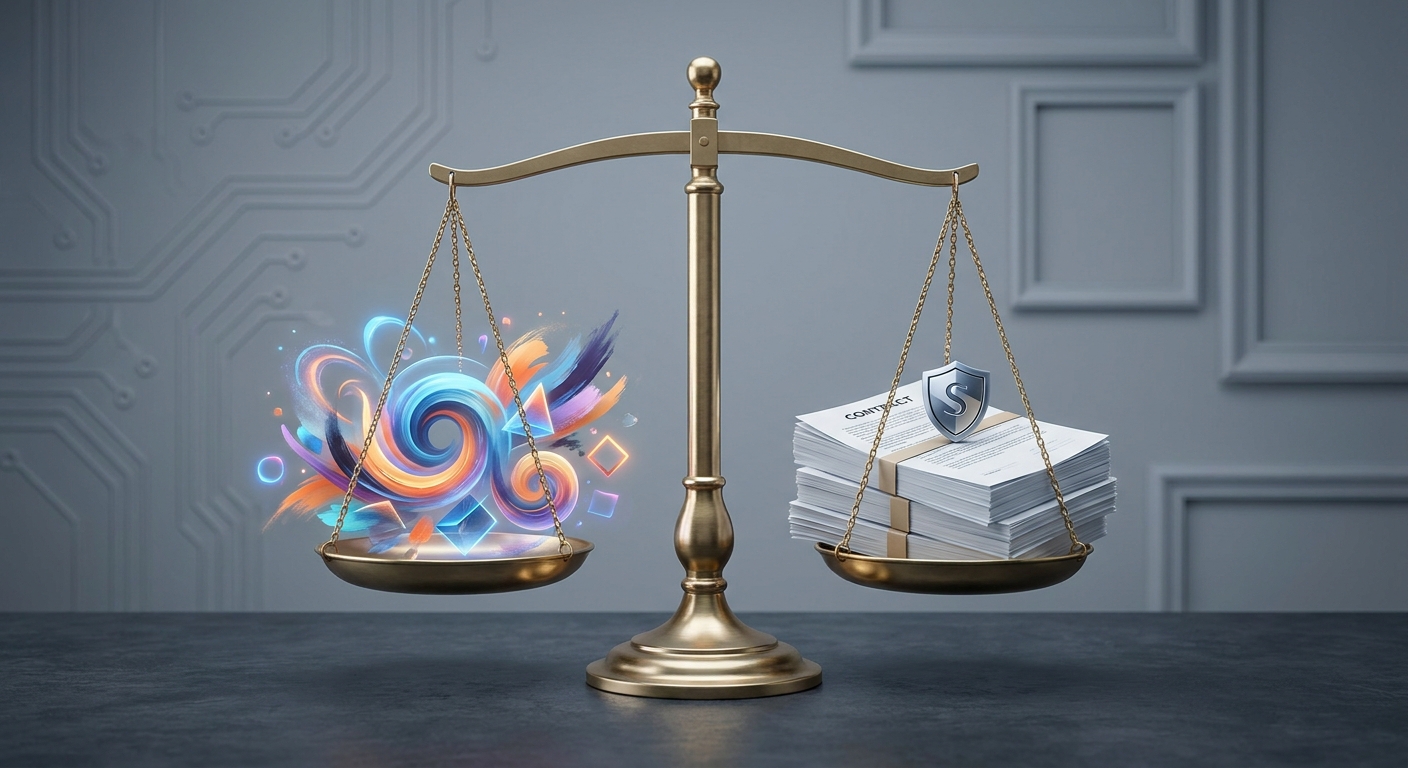
Real-world risk scenarios for small businesses
Use these scenarios to pressure test your current process:
- Website hero images: A prompt references a brand name product on a desk. The resulting image shows a confusingly similar logo. You publish it—then receive a complaint and your hosting provider asks you to remove it.
- Social ad creative: You ask a model to mimic the “style of [Living Artist].” The output looks like a near match. The artist’s representatives file a platform complaint; your ad account is temporarily restricted during review.
- Client deliverable: A marketing agency provides AI visuals under tight deadlines without documenting licenses. The client later reuses the image in print. A stock platform claims the background resembles a licensed photo and demands proof; you lack records.
- Merch and packaging: An AI pattern includes an element that echoes a popular character silhouette. A marketplace removes your listing on suspicion of infringement; reinstatement requires proof you cannot provide.
- Employee uploads: A staffer uploads a real person’s photo to “enhance” it with AI and posts the result on your blog. The person demands removal and compensation for commercial use of their likeness.
In each case, the operating risk isn’t just “will you win in court?” It’s downtime, lost sales, make‑goods to clients, and trust erosion. Prevention is cheaper than response.
A 7‑Layer IP Risk Mitigation Framework for AI visuals
Adopt these layers to operationalize safe, scalable creative output:
-
Policy & training
- Publish a one‑page AI Visuals Policy: acceptable models, prohibited prompts (e.g., “in the style of [Living Artist]”), required review steps, and escalation paths.
- Train staff on basic IP concepts: copyright, trademarks, releases, and why “found online” does not equal “free.”
-
Approved tools & model governance
- Use models/platforms with commercial licenses and enterprise controls. Prefer providers that offer indemnity or clear terms.
- Track model versions and settings; changing defaults can change rights.
-
Prompt hygiene & style guidance
- Ban prompts that target living artists’ names or copyrighted properties.
- Encourage descriptive attributes and references to public‑domain styles (e.g., “mid‑century poster aesthetic”) rather than specific individuals’ styles.
-
Provenance & authenticity
- Embed and preserve content credentials where possible (e.g., initiatives like content provenance standards). Consider tools that support secure “content credentials” workflows.
- Keep an AI Visual Asset Register with: project, prompt(s), negative prompts, model/version, source platform, seed (if available), date/time, human edits, references, license terms, releases, and final approvals.
-
Human review & clearance
- Implement a 3‑minute rights check: logos/marks, famous characters, look‑alike trade dress, recognizable people, watermarks, and artist‑style proximity.
- Run sensitive images through reverse‑image search or internal similarity checks to catch near matches to existing works.
-
Contracts & indemnity
- With vendors/agencies, require warranties of non‑infringement, assignment of rights, and cooperation in takedowns/disputes.
- Consider media liability coverage or endorsements for AI‑related IP claims; review exclusions with your broker.
-
Incident response
- Create a simple playbook: pause distribution, log facts, consult counsel, and respond politely and promptly to complaints.
- For platforms, follow their specific dispute/takedown procedures; time matters to prevent account restrictions.
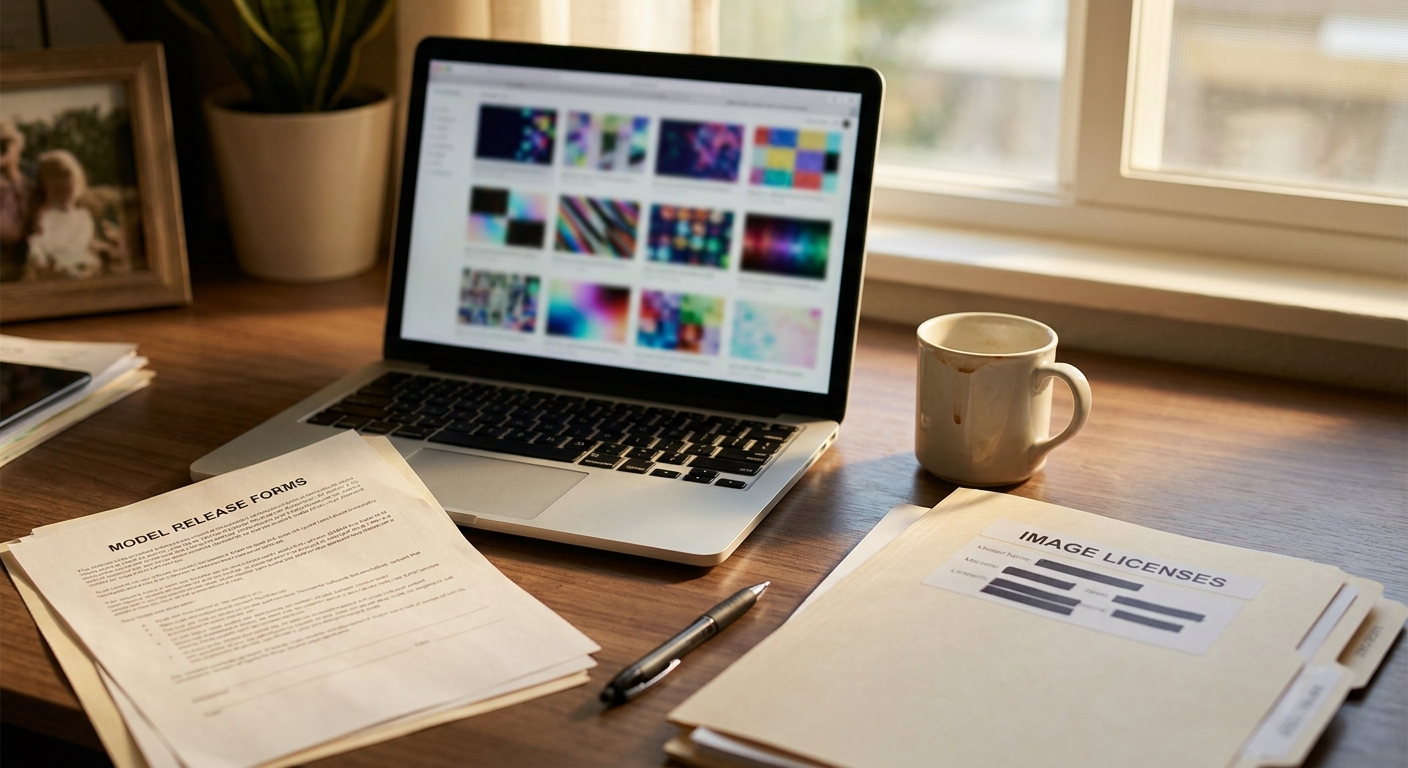
Comparison table: Safer AI image sourcing options
Use this table to choose the right approach per project based on risk, speed, and documentation strength.
| Sourcing Option | License Clarity | Provenance Transparency | Speed | Relative IP Risk | Best For |
|---|---|---|---|---|---|
| Enterprise AI generator with commercial terms | High (explicit commercial license; some offer indemnity) | Medium–High (model/version recorded; credentials possible) | Very fast | Low–Medium | Ads, web, social, pitch decks |
| Stock library with AI images + clear licensing | High (standard stock agreements; model releases available) | High (asset IDs, releases, usage types tracked) | Fast | Low | Commercial campaigns, print, client work |
| Commissioned human artist with AI‑assisted workflow | High (contract assigns rights; custom scope) | High (source files, process notes) | Medium | Low | Branding, packaging, unique visuals |
| Open‑source model self‑hosted | Medium (review model + dataset + license stack) | Medium (you control logs; diligence varies) | Fast after setup | Medium | In‑house creative teams with governance |
| Random internet image “found on social” | Low (no rights) | Low (unknown source) | Fast | High | Never for business use |
Procurement checklist and contract clauses to reduce risk
When you buy, commission, or accept AI‑assisted visuals, use this short checklist and clause language as a starting point. Consult your attorney for final wording.
AI Visuals Procurement Checklist
- Source disclosure: Which platform/model/version produced the image? Include asset links or IDs.
- License proof: Attach the license, terms of use excerpt, and a screenshot of grant of rights.
- Releases: If people or private property appear, attach model/property releases.
- Similarity check: Vendor attests to conducting a similarity search and retaining logs.
- No restricted prompts: Written confirmation that living artists’ names and protected brands were not used.
- Assignment of rights: All rights assigned upon payment; no conflicting encumbrances.
- Indemnification: Vendor indemnifies for third‑party IP claims arising from supplied assets.
- Content credentials: Embed and preserve content provenance metadata when feasible.
Sample Clause Starters (adapt to your agreements)
- Warranties: “Vendor represents and warrants that all Deliverables are original or properly licensed, do not infringe any copyright, trademark, or right of publicity, and do not incorporate third‑party materials without written permission.”
- Disclosure: “Vendor shall disclose any use of generative AI, including the model name and version, prompts reasonably necessary to evidence authorship and licensing, and maintain logs for 24 months.”
- Indemnity: “Vendor shall defend, indemnify, and hold Client harmless from any third‑party claims alleging that the Deliverables infringe intellectual property or publicity rights, including reasonable attorneys’ fees.”
- Remedies: “If a Deliverable is alleged to infringe, Vendor will, at its expense, replace or modify the Deliverable to be non‑infringing with materially equivalent functionality and aesthetics, or refund all fees paid for that Deliverable.”
- Takedowns: “Upon notice of a credible claim, Vendor will cooperate in immediate suspension of use and in all platform or marketplace takedown processes.”
30‑60‑90 day implementation roadmap and KPIs
Here’s a practical timeline to operationalize responsible AI imagery without slowing your marketing team.
Days 1–30: Baseline and guardrails
- Draft and publish your one‑page AI Visuals Policy. Include prohibited prompts and the 3‑minute rights check.
- Whitelist approved tools/platforms with commercial terms. Document model versions and default settings.
- Set up the AI Visual Asset Register (a shared folder or database). Add mandatory fields to your creative briefs.
- Run a 60‑minute training on copyright, trademarks, and releases for anyone who touches visuals.
- Define a simple incident response: who pauses content, who reviews, and who replies to complaints.
Days 31–60: Workflows and vendor alignment
- Integrate rights checks into your design/PM tool (e.g., a checklist on the task template before “Done”).
- Amend freelancer and agency agreements with disclosure, warranties, and indemnity.
- Adopt content provenance where feasible and ensure exported assets preserve metadata.
- Pilot a reverse‑image similarity review for hero images and print campaigns.
- Establish an approvals rubric for high‑visibility assets (e.g., web homepage, OOH, packaging).
Days 61–90: Optimize and insure
- Measure cycle time from brief to approved asset; streamline bottlenecks without skipping checks.
- Review one quarter of existing top‑performing images; re‑document or replace anything without clear provenance.
- Discuss media liability coverage or policy riders with your broker; clarify AI‑related exclusions.
- Create a “safe style library” of reference aesthetics and palettes that avoid artist‑specific prompts.
- Document a repeatable remediation playbook for takedowns and claims.
KPIs to watch
- 0 unlicensed assets published (measured via asset register completeness)
- 100% of vendor deliverables include license proof and releases where applicable
- Time‑to‑approve for new images ≤ 2 business days on average
- Incident response time from complaint to pause ≤ 2 hours
- Training coverage ≥ 90% of relevant staff within 60 days
Additional practical tactics for safer AI imagery
- Prefer public‑domain and open‑licensed references: When moodboarding, anchor to public‑domain works or assets with clear Creative Commons terms that allow commercial use. Always capture the license and URL.
- Build human‑plus workflows: Treat AI as a draft generator. Composite, retouch, and layout in human‑led design tools to shape unique expression and reduce similarity risks.
- Use negative prompts: Add negatives like “no logos, no brand names, no watermarks, no celebrities” to reduce problematic elements.
- Check alt text and captions: Don’t inadvertently imply endorsement or association in your copy even when the image is clean.
- Maintain a disposal policy: If an asset is flagged or disputed, archive it with “do not use” tags and remove from shared libraries.
- Know your platforms: Advertising and marketplace platforms have their own content policies. Align your checks with the strictest platform you use.
- When in doubt, license stock: For critical assets (homepage banners, packaging, PR), a reputable stock license with releases is often the most efficient low‑risk path.
Helpful resources
For foundational reading and policy templates, explore:
- U.S. Copyright Office – plain‑language overviews of copyright basics and fair use factors.
- Content Provenance and Authenticity initiatives – learn about content credentials and provenance standards.
Important: This article provides general information, not legal advice. Consult qualified counsel for guidance on your specific situation and jurisdiction.
Conclusion
AI imagery can supercharge small‑team creativity—but only when paired with disciplined governance. Treat every visual like a business asset: know where it came from, what you’re allowed to do with it, and who signed off. By combining clear policies, approved tools, a simple rights check, and airtight documentation, you’ll cut the noise around “AI art theft” and focus on what matters: memorable, on‑brand visuals that you can confidently publish, sell, and scale. Start with the 7‑Layer Framework, implement the 30‑60‑90 plan, and turn responsible creativity into a durable competitive advantage.
Ready to explore how you can streamline your processes? Reach out to A.I. Solutions today for expert guidance and tailored strategies.