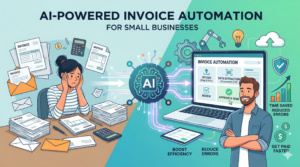

Small business owners don’t lose time in big chunks—they lose it in dozens of tiny “must-do” tasks: answering the same customer questions, chasing invoices, updating spreadsheets, scheduling jobs, and following up on leads. AI agents can quietly take over much of that routine work while you stay in control of decisions and customer relationships. This week’s goal: understand what AI agents are, where they help most, and how to deploy them affordably without turning your business into an IT project.
Table of Contents
- What AI Agents Are (and What They Aren’t)
- High-Impact Use Cases for Small Businesses
- A Practical Deployment Playbook (Step-by-Step)
- Affordable Tools and Platforms to Build AI Agents
- A Simple AI Agent Workflow You Can Copy
- Common Challenges (and How to Solve Them)
- How to Measure ROI: Time Saved, Revenue Protected, Customers Delighted
- What to Do This Week: A 60-Minute Action Plan
What AI Agents Are (and What They Aren’t)
An AI agent is software that can take a goal (for example, “respond to new website inquiries within 5 minutes” or “follow up with overdue invoices”) and then execute a series of steps across your tools—often with minimal supervision. Unlike a basic chatbot that only answers questions, an agent can:
- Read and categorize incoming information (emails, forms, messages)
- Decide what to do next using rules and/or AI reasoning
- Take actions in other systems (CRM updates, appointment scheduling, generating quotes, creating tasks)
- Escalate to a person when confidence is low or a situation is sensitive
What agents aren’t: a replacement for your team’s expertise or a “set it and forget it” magic button. The winning approach for small businesses is a human-in-the-loop model—agents handle repetitive work, humans handle exceptions, approvals, and relationship-building.
Industry insight: Organizations often see the fastest gains when AI is used to automate repeatable workflows (triage, drafting, routing, and follow-up) rather than fully autonomous decision-making. The practical sweet spot is “assist + automate,” with clear handoffs to humans.
High-Impact Use Cases for Small Businesses
If you’re wondering where to start, focus on workflows that are frequent, predictable, and tied to revenue or customer experience. Here are proven categories that translate well across industries.
1) Customer engagement and faster responses
- Website lead intake: An agent reads form submissions, asks 1–3 clarifying questions, and routes hot leads to sales immediately.
- FAQ and support deflection: An agent answers common questions (hours, pricing ranges, availability, policies) and creates tickets only when needed.
- Appointment scheduling: An agent proposes times, books meetings, sends reminders, and updates your calendar/CRM.
2) Sales follow-up that doesn’t slip
- Lead qualification: Score leads using your criteria (service area, budget, timeline) and move them to the right pipeline stage.
- Quote assistance: Drafts estimate templates based on intake details; you review and send.
- Nurture sequences: Personalizes follow-ups (“Still looking for gutter repair in April?”) without sounding robotic.
3) Operations and admin automation
- Invoice follow-ups: Sends polite reminders, answers basic billing questions, and flags accounts that need a call.
- Job intake to task creation: Converts an email request into a work order, checklist, and internal assignment.
- Document generation: Creates contracts, onboarding packets, SOPs, and meeting summaries from templates.
4) Internal knowledge and training
- “Ask the business” assistant: Team members ask, “What’s our return policy?” or “How do I process a refund?” and get the correct SOP.
- New hire ramp-up: An agent answers training questions and points to internal resources, reducing owner interruptions.
A Practical Deployment Playbook (Step-by-Step)
Small businesses win with AI when they treat it like process improvement, not a science project. Use this playbook to deploy your first agent in a controlled, low-risk way.
Step 1: Pick one workflow with clear boundaries
Choose a task that happens often and has a definable “done” state. Good starters:
- Respond to new leads (collect details + route to you)
- Schedule appointments (confirm service type + book + reminders)
- Draft customer replies for common requests (you approve before sending)
Avoid starting with complex edge-case processes like dispute resolution, HR performance issues, or anything requiring legal judgment.
Step 2: Define success metrics before you build
Make the goal measurable. Examples:
- Reduce average first-response time from 6 hours to 10 minutes
- Cut time spent on scheduling by 70%
- Increase lead-to-appointment conversion by 10%
- Reduce overdue invoices (30+ days) by 15%
Step 3: Map your “happy path” and escalation rules
Write the simple version first. Then define when the agent must hand off to a human. Escalation triggers might include:
- Customer requests a refund or threatens a negative review
- High-value deal size over a set threshold
- Anything involving medical, legal, or sensitive personal data
- Low confidence (agent can’t find an answer in your knowledge base)
Step 4: Prepare your data (lightweight, not perfect)
AI agents perform best when they have a reliable source of truth. Start with:
- A single FAQ or policy document (Google Doc is fine)
- Your services list, service area, and pricing guidelines (ranges are okay)
- Templates: email responses, quote structure, appointment rules
Keep it current. Outdated info is the fastest way to lose trust.
Step 5: Choose your tool approach (no-code first)
Most small businesses can deploy effective agents with no-code or low-code platforms. Your choice depends on where conversations happen (website chat, email, SMS, social DMs) and which systems need to be updated (CRM, calendar, invoicing).
Step 6: Launch in “draft mode” and test for one week
Before you let an agent send messages on its own:
- Have it draft replies for approval
- Test with 20–50 real interactions
- Track: accuracy, time saved, and customer satisfaction signals
Step 7: Gradually increase autonomy with guardrails
Once performance is consistent:
- Allow auto-replies for low-risk FAQs
- Keep approval required for pricing, refunds, and custom quotes
- Use logging: store conversations and actions taken for review
Affordable Tools and Platforms to Build AI Agents
Below is a practical comparison of tools small businesses commonly use to deploy AI agents. Pricing changes frequently, so treat costs as “typical starting points” and confirm on vendor sites.
| Tool/Platform | Best For | Typical Starting Cost | Strengths | Watch Outs |
|---|---|---|---|---|
| ChatGPT (Teams/Business) or similar AI assistant | Drafting replies, internal assistant, SOP Q&A | $20–$30/user/month (varies by plan) | Fast to start; great for writing, summarizing, brainstorming | Needs clear prompts and policies; not a full workflow tool by itself |
| Microsoft 365 Copilot / Google Workspace AI features | Email, docs, meetings, internal productivity | Add-on pricing varies | Works where your team already lives (Outlook/Docs/Sheets) | Value depends on adoption; needs governance |
| Zapier + AI steps | Connecting apps; routing, task creation, notifications | Free tier + paid plans | Easy integrations; great for “if this, then that” automation with AI in the middle | Costs can rise with volume; requires clean workflows to avoid mess |
| Make (Integromat) | More complex automations and branching workflows | Free tier + paid plans | Powerful logic; cost-effective at scale for some use cases | Slightly steeper learning curve than Zapier |
| CRM built-in AI (HubSpot, Zoho, etc.) | Lead management, follow-ups, pipeline hygiene | Often included/available on paid tiers | AI tied directly to customer records and sales process | Setup matters; avoid duplicating systems |
| Website chat tools with AI (varies by provider) | 24/7 lead capture and FAQ handling | $0–$100+/month depending on features | Immediate customer-facing value; reduces missed leads | Needs a knowledge base and escalation path to humans |
Budget tip: If you already pay for Microsoft 365 or Google Workspace, start there for internal efficiency, then add one automation platform (Zapier or Make) to connect systems. Many businesses can get meaningful results with just those pieces.
A Simple AI Agent Workflow You Can Copy
Use this framework to design almost any agent. It keeps things predictable and easy to improve over time.
Workflow Framework: “Listen → Understand → Decide → Do → Escalate → Learn”
- Listen: Capture messages from chat, email, SMS, or forms.
- Understand: Extract key details (name, request type, urgency, budget/timeline).
- Decide: Apply rules (service area? business hours? existing customer?) and confidence thresholds.
- Do: Take action (send response, book time, create ticket, update CRM).
- Escalate: Hand off to a human with a concise summary and recommended next step.
- Learn: Log outcomes, add new FAQs, update templates, refine prompts.
Common Challenges (and How to Solve Them)
AI adoption issues are rarely “AI problems.” They’re usually process, clarity, or expectations problems. Here are the most common roadblocks and practical fixes.
Challenge 1: “The agent sounds robotic”
Solution: Give it a brand voice guide and examples.
- Write 5–10 example replies you love (your best “real you” messages)
- Specify tone: friendly, direct, no pressure, simple language
- Require short answers first, then offer details (“If you’d like, I can…”)
Challenge 2: “It gives wrong or inconsistent answers”
Solution: Limit what it’s allowed to answer and point it to a single source of truth.
- Start with FAQs and policies only
- Use “If not found, escalate” rules
- Review conversation logs weekly and fix the top 10 gaps
Challenge 3: “My tools don’t connect”
Solution: Use one integration hub and reduce app sprawl.
- Pick Zapier or Make as your “plumbing”
- Standardize on one CRM (even a lightweight one) instead of multiple lists
- Use webhooks or email parsing when direct integrations don’t exist
Challenge 4: Data privacy and customer trust
Solution: Set clear boundaries and be transparent.
- Avoid collecting sensitive data unless truly necessary
- Use role-based access for internal agent tools
- Add a simple disclosure in chat like: “This assistant can help with scheduling and basic questions. A team member will step in for anything complex.”
Challenge 5: Team resistance (“Is this replacing me?”)
Solution: Position agents as workload protection, not headcount reduction.
- Start by removing the most annoying repetitive tasks
- Invite staff to nominate tasks for automation
- Assign ownership: one person monitors outcomes and suggests improvements
How to Measure ROI: Time Saved, Revenue Protected, Customers Delighted
If you don’t measure outcomes, AI becomes “something we tried” instead of “how we operate.” Track a mix of speed, quality, and revenue indicators.
| Metric | Baseline Example | Target With AI Agent | Why It Matters |
|---|---|---|---|
| First response time to leads | 2–8 hours | < 10 minutes | Speed wins deals; reduces missed opportunities |
| Appointments booked per week | 10 | 12–14 | More bookings without extra admin effort |
| Owner/admin hours spent on scheduling | 5 hours/week | 1–2 hours/week | Frees time for sales, delivery, and leadership |
| Support tickets created for FAQs | 30/month | 10–15/month | Deflects repetitive questions; keeps team focused |
| Overdue invoices (30+ days) | $8,000 | $6,500 | Automated follow-up improves cash flow |
Simple ROI math: If an agent saves 4 hours/week and your fully loaded admin time is $30/hour, that’s about $480/month saved—often enough to pay for the tool stack, with faster responses and better follow-up as upside.
What to Do This Week: A 60-Minute Action Plan
You don’t need a full “AI transformation.” You need one useful agent that reliably removes a bottleneck.
Minute 0–15: Pick one workflow
- Choose: lead reply, scheduling, or invoice follow-up
- Write the start trigger (e.g., “new web form submitted”)
- Write the end state (e.g., “appointment booked” or “task created”)
Minute 15–35: Gather your “source of truth”
- Copy your top 15 FAQs into one document
- List pricing guidance (ranges + what affects price)
- Write 3–5 sample responses in your voice
Minute 35–60: Prototype with guardrails
- Set the agent to draft mode (approval required)
- Add escalation rules for refunds, angry customers, and custom pricing
- Test with 5 real scenarios and refine wording
If you do only one thing: get your first-response time down. In many small businesses, that single improvement pays for everything else.
Final Takeaways
AI agents can help small businesses compete by automating routine work, responding faster to customers, and keeping operations moving without constant owner intervention. Start small: pick one workflow, define success metrics, build a simple knowledge base, and launch with human approval before increasing autonomy. The best results come from clear guardrails, consistent escalation to humans, and continuous improvement based on real conversations—not perfection on day one.
A.I. Solutions: If you want help selecting tools, designing a safe workflow, and deploying an AI agent that actually saves time in your business, contact A.I. Solutions here.