
Introduction: The Matter Lifecycle Disconnect
In the modern legal industry, the lifecycle of a legal matter is heavily front-loaded with administrative rigor and intense scrutiny. During the client intake phase, law firms execute exhaustive procedures designed to protect the firm’s commercial interests and ethical standing. Comprehensive conflict checks are run across global databases to mitigate risk, engagement letters are meticulously drafted to define the exact scope of representation, and sophisticated financial arrangements are codified into billing systems before a single hour of work is billed1. This process is highly structured, universally enforced, and supported by enterprise-grade software precisely because it directly impacts revenue generation.
However, a glaring operational dichotomy exists at the opposite end of the matter lifecycle. When a case settles, a transaction closes, or a judicial opinion is handed down, the administrative machinery frequently grinds to a halt1. While law firms possess stringent practices for opening matters, they possess little to no enforceable processes that work in practice for closing matters and systematically offloading the associated data2. The actual conclusion of a matter is often reduced to generic, menial steps, such as marking a billing code as “inactive” in the financial system to suspend time entry, and sending physical file boxes to offsite warehouse storage2. The digital footprint of the matter is almost entirely ignored.
This operational blind spot has created an uncomfortable truth within the legal profession: no evidence truly goes away. Corporate clients, bound by strict regulatory frameworks and internal information governance policies, invest millions of dollars in defensible data disposition. These clients operate under the assumption that documents, correspondence, and records related to closed matters have been safely cycled out of existence by their own document retention policies. They have virtually no insight into the fact that their outside counsel possesses identical, unmanaged copies of this data sitting indefinitely on dormant network shares3.
The failure to close files and securely dispose of client data is no longer merely an IT storage issue; it is a critical vulnerability. As data volumes explode and cyber threats become increasingly sophisticated, the indefinite retention of client data transforms law firms from trusted legal advisors into highly lucrative targets for cybercriminals and aggressive regulatory bodies3. Addressing this epidemic requires a fundamental shift in how the legal industry views the end of the matter lifecycle, moving away from a culture of ad-hoc data hoarding toward structured, automated, and AI-driven defensible disposition that satisfies client obligations and regulatory mandates.
The Historical Accumulation of Legal Dark Data

To comprehend the sheer magnitude of the data retention crisis within modern law firms, one must examine the technological evolution of the legal industry over the past three decades, particularly the explosive rise of electronic discovery (e-discovery).
The Over-Collection Imperative
In the early days of e-discovery, preceding the modern refinement of the Federal Rules of Civil Procedure (FRCP) regarding electronically stored information (ESI), the prevailing litigation methodology was driven by a fear of missing critical evidence5. Legal teams lacked the sophisticated early case assessment tools available today. Consequently, the standard operating procedure dictated a strategy of massive over-collection. Forensic vendors and litigation support teams routinely instructed corporate clients to export entire mailboxes for triage, or to clone entire network drives so that the law firm could filter the data internally6.
This brute-force approach resulted in terabytes of raw, unstructured client data being transferred to law firm networks. Because these massive collections occurred long before the legal industry realized the acute need for standard operating procedures enveloping the data lifecycle, much of this information was saved directly to unrestricted network file shares7. It was stored in non-standard directories, completely divorced from the firm’s official Document Management System (DMS), and entirely hidden from the oversight of records management professionals5.
The Legacy Media and Naming Convention Crisis
The formatting and storage mediums of this era further compounded the retention disaster. In the 1990s and early 2000s, discovery data was frequently transferred via physical media that is now entirely obsolete, prone to rapid physical degradation, and virtually impossible to analyze with modern hardware, including JAZ drives, ZIP disks, and floppy disks.
Furthermore, much of this historical data is bound by the severe limitations of legacy file systems, particularly the 8.3 filename format dictated by early FAT (File Allocation Table) architectures. Under the 8.3 convention, files were limited to eight characters followed by a three-character extension (e.g., SMITHVJ1.DOC). These naming conventions are incredibly non-descriptive, stripping the file of any contextual metadata that might indicate its relevance, its association with a specific client, or its sensitivity level. Today, analyzing millions of legacy files bearing truncated, cryptic names represents a monumental, highly expensive challenge for information governance professionals attempting to map and categorize dark data7.
The DLT Backup and Cloud Migration Failure
As network shares swelled with over-collected e-discovery data, law firm IT departments sought ways to manage the storage burden while ensuring disaster recovery. They relied heavily on Digital Linear Tape (DLT) backup libraries10. These sequential-access tapes captured complete, bit-for-bit images of entire servers or network shares. However, these backups were executed exclusively with a focus on catastrophic system restoration, with absolutely no regard for the actual content of the directories or the retention schedules of the underlying client data.
When the legal industry eventually modernized and transitioned from on-premises infrastructure to cloud-based storage, the dark data problem was magnified rather than resolved. Rather than using the migration as a strategic opportunity to curate data, categorize files, and execute defensible disposition, a vast majority of firms opted for a “lift and shift” approach11. They took poorly labeled DLTs and massive, unstructured network shares and migrated them wholesale into cloud environments.
The cloud provided the illusion of infinite, cheap storage, removing the physical space constraints that previously forced firms to clean out server rooms. Consequently, law firms inadvertently built massive, unindexed archives of highly sensitive “dark data”—information that the organization collects, processes, and stores during regular business activities, but generally fails to classify, control, or use for other purposes7.
| Storage Era | Prevailing Media/Formats | Information Governance Challenge | Broad Risk Profile |
| Early e-Discovery (1990s) | Floppy disks, JAZ, ZIP, 8.3 filenames | Data is siloed, rapidly degrading, and utterly lacks descriptive metadata for classification. | High physical loss risk; severe difficulty in fulfilling data subject access requests or identifying clients. |
| Network Expansion (2000s) | On-premises SAN/NAS, unstructured network shares | Over-collected ESI dumped into non-standard directories outside the official Document Management System (DMS). | High risk of unauthorized internal access; loss of chain of custody; profound spoliation risks. |
| Tape Archiving (2000s-2010s) | Digital Linear Tape (DLT) libraries | Backups captured entire servers indiscriminately, bypassing matter-specific retention schedules. | “Keep everything forever” default; exorbitant costs and technical barriers to restore and review tapes. |
| Cloud Migration (2010s-Present) | AWS, Azure, Cloud DMS (e.g., iManage, NetDocuments) | “Lift and shift” migrations moved dark data into the cloud without curation, masking the sheer volume of obsolete data. | High cybersecurity risk (cloud misconfigurations); massive aggregate liability for data breaches; shadow AI risks. |
The Weaponization of Over-Retention: Cybersecurity and Regulatory Realities

The failure to implement a functional matter closing and data offloading process is no longer a benign administrative oversight; it represents an existential threat to modern legal practice. The indefinite retention of dark data exposes law firms to severe cybersecurity, regulatory, and contractual liabilities3.
The Cybersecurity Threat Vector
Law firms are highly attractive targets for cybercriminals and state-sponsored threat actors because they aggregate the most sensitive data of the world’s largest corporations—including trade secrets, pending merger and acquisition (M&A) details, intellectual property, and protected health information (PHI)3. By failing to close matters and destroy data, law firms exponentially increase their attack surface.
The financial logic of data destruction is irrefutable: it is mathematically impossible for a threat actor to exfiltrate data that no longer exists15. The devastating consequences of retention amnesia are well-documented and frequently severe. In 2023, the prominent law firm Orrick, Herrington & Sutcliffe suffered a data breach that exposed the personal information of over 637,000 individuals3. The sheer volume of exposed individuals was directly attributable to the firm’s aggregation of data from historical employment litigation, M&A transactions, and legacy filings1. Because lawyers traditionally “keep everything forever” due to a risk-averse culture, data from cases dating back decades often sits on legacy systems, creating a cumulative breach exposure that adds massive liability to the firm’s ledger year over year1.
When highly sensitive, sealed, or privileged documents are leaked to the dark web, the damage is irreversible. While courts generally hold that a data breach does not automatically waive the attorney-client privilege, the practical harm to the client’s competitive advantage and public reputation cannot be undone17. This inevitably leads to immediate class-action litigation against the law firm and severe, lasting reputational damage that impacts future business development17.
Regulatory Scrutiny and the Covington Subpoena
Beyond direct financial losses from cyberattacks, law firms holding legacy client data are increasingly subject to aggressive regulatory scrutiny. A watershed moment for the legal industry occurred when the U.S. Securities and Exchange Commission (SEC) issued a subpoena to the law firm Covington & Burling19. The SEC sought the names of nearly 300 publicly traded clients whose non-public information may have been compromised during a sophisticated cyberattack on the firm’s networks3.
While a federal judge eventually narrowed the scope of the subpoena to seven clients, the legal precedent was firmly established: law firms cannot completely shield client identities or data from regulators in the aftermath of a breach1. This incident underscores the severe regulatory risk of over-retention. If a firm retains data for a matter that concluded ten years ago, and that data is subsequently breached, the firm may be forced into a highly adversarial and public dispute with federal regulators, potentially breaching ongoing ethical duties of confidentiality to former clients simply because the data was never purged3.
Ethical Duties, Privacy Legislation, and Outside Counsel Guidelines
The regulatory and contractual landscape surrounding data retention has fundamentally shifted, stripping away the legal profession’s historical exemptions.
From an ethical standpoint, the American Bar Association (ABA) Model Rules of Professional Conduct are explicitly clear. Model Rule 1.1 requires attorneys to maintain technological competence, while Model Rule 1.6 mandates that lawyers must make reasonable efforts to prevent the inadvertent or unauthorized disclosure of, or unauthorized access to, client confidences19. Furthermore, Model Rule 1.16(d) requires a lawyer to take steps to the extent reasonably practicable to protect a client’s interests upon termination of representation, which includes surrendering papers and property to which the client is entitled23. Storing client property indefinitely on unmonitored network shares violates the spirit, if not the letter, of these rules.
Corporate clients have recognized the profound supply-chain risk posed by their outside counsel. In response, institutional clients are leveraging their purchasing power to enforce strict Outside Counsel Guidelines (OCGs)26. These binding contractual frameworks frequently mandate that law firms adhere to stringent security standards (such as ISO 27001 or SOC 2 Type II), restrict data access based on the principle of least privilege, and, crucially, enforce strict data retention and destruction schedules26. Major clients now routinely require formal Certificates of Destruction to prove that their data has been rendered mathematically irretrievable once a matter concludes28.
Furthermore, global data privacy regulations, including the European Union’s General Data Protection Regulation (GDPR) and the California Privacy Rights Act (CPRA), legally enforce the concept of “data minimization”30. These statutes stipulate that personal data must not be kept longer than is necessary for the purposes for which it is processed. Law firms that retain legacy files containing personally identifiable information (PII) without a valid legal basis or active client consent are in direct violation of these statutes, exposing themselves to massive regulatory fines and professional disciplinary action14.
The Spoliation Fallacy vs. Defensible Disposition
If the financial, regulatory, and cybersecurity risks of over-retention are so severe, why do law firm partners vehemently resist closing files and deleting data? The primary friction stems from a deeply ingrained, yet legally flawed, fear of spoliation.
Spoliation is the intentional, negligent, or accidental destruction of evidence relevant to a pending or reasonably anticipated lawsuit31. Many attorneys operate under the false assumption that deleting any document, even decades after a matter has concluded, might somehow be construed as spoliation if that document is unexpectedly deemed relevant to a future, unforeseen dispute11. This hyper-conservative “keep it just in case” mentality paralyzes firm-wide information governance efforts, leading general counsels within law firms to halt data destruction programs out of an abundance of caution.
However, modern jurisprudence and federal rules provide clear safe harbors for organizations that systematically manage their data. Federal Rule of Civil Procedure (FRCP) 37(e) specifically addresses the failure to preserve ESI. Courts have consistently ruled that the routine, good-faith operation of an established document retention and destruction policy does not constitute spoliation, provided there is no active duty to preserve (such as an active litigation hold) and the destruction was not executed with an “intent to deprive” another party of the information’s use in the litigation33.
As articulated by The Sedona Conference’s Commentary on Defensible Disposition, organizations are legally permitted and actively encouraged to dispose of their information when there is no longer a legal retention, regulatory, or business obligation to keep it29. Defensible disposition is the systematic execution of a documented retention policy5. By transitioning from ad-hoc, manual deletion (which often looks suspicious to courts) to automated, policy-driven disposition, law firms can definitively shield themselves from spoliation claims while shedding terabytes of toxic liability39.
Modernizing Matter Closure: Process, Policy, and Future Needs
To bridge the gap between matter opening and matter closing, law firms must elevate the “Matter Conclusion” phase to the same level of strategic and administrative importance as client intake2. Closing a matter cannot simply mean that billing has ceased; it must involve a choreographed, cross-departmental workflow encompassing Records & Information Management (RIM), Information Technology (IT), Accounting, and the lead attorneys2.
Defining the Trigger Event and Executing Closure
The foundational step in a defensible retention policy is identifying the “trigger event” that initiates the retention countdown2. Common triggers include the execution of a settlement agreement, a final judicial ruling, the expiration of an appeal period, or the formal termination of the attorney-client relationship41.
Because many matters drift into dormancy without a clear, defined conclusion, modern Document Management Systems (DMS) such as iManage and NetDocuments can assist in identifying silent closures. Information governance software can monitor metadata, such as the “last edit date” of a document or the last recorded time entry in the financial system, to flag inactive matters and automatically prompt the supervising partner to initiate the closure workflow2.
Once triggered, a standardized administrative workflow must commence:
- Financial Reconciliation: The accounting department ensures all trust account balances are resolved, outstanding fees are collected, and the matter is locked for future time entries to prevent data drift and silent modifications44.
- Client Communication: Under ABA guidelines, a formal closing letter must be drafted, outlining the conclusion of the representation, returning original physical documents, and clearly stating the firm’s document retention policy. This alerts the client that all remaining digital and physical files will be permanently destroyed at the end of the retention period (e.g., seven years), setting clear contractual expectations44.
- Data Consolidation: All data related to the matter, scattered across unmanaged network shares, email inboxes, Microsoft Teams, and individual hard drives, must be identified, consolidated into the central repository, and placed under a locked retention schedule to prevent further proliferation8.
Balancing Disposition with Future Follow-Up Matters
A common objection from partners is that destroying case files eliminates valuable institutional knowledge necessary for future follow-up matters or similar litigation. To resolve this tension, law firms must decouple raw client data from curated legal precedent.
During the matter closure workflow, attorneys should be prompted to identify high-value work product (e.g., successful motions, novel contract clauses, expert witness dossiers). These specific documents should be stripped of personally identifiable information (PII) and sensitive client data, then migrated to a dedicated Knowledge Management (KM) system. By deliberately curating an anonymized precedent library, the firm retains the strategic intellectual property of the case while allowing the vast bulk of the toxic, raw discovery data and unredacted correspondence to be securely destroyed at the end of the retention period.
Leveraging Automation and Generative AI for Data Remediation

While establishing policies for day-forward matter closure is relatively straightforward, remediating decades of unindexed dark data stored on legacy network shares requires advanced technological intervention. Human review of petabytes of 8.3 filenames and fragmented data is financially impossible; the life-to-date offsite storage and review cost of these records can easily exceed the revenue generated by the matter itself7. Consequently, law firms must leverage automation, machine learning, and Generative Artificial Intelligence (GenAI) to execute defensible disposition at scale30.
Automated Data Discovery and Auto-Classification
The first step in remediating dark data is establishing visibility. Modern enterprise information governance platforms utilize AI-driven data crawlers to scan unstructured network shares, legacy cloud backups, and active repositories30. Rather than relying on humans to manually read cryptic file names, Natural Language Processing (NLP) algorithms analyze the actual binary content of the documents.
These systems are capable of performing complex entity extraction. By cross-referencing extracted names, dates, jurisdiction codes, case numbers, and legal terminology against the firm’s financial and matter management databases, the AI can successfully map orphaned files back to their originating matters30. Once a file is identified and linked to a closed matter, the system automatically applies the appropriate retention policy tag, calculates the disposition date based on jurisdictional rules, and flags the file for destruction if the retention period has already expired30.
Furthermore, AI is exceptionally adept at identifying Redundant, Obsolete, and Trivial (ROT) data. Concept clustering and predictive coding can group duplicate emails, outdated system logs, and draft documents, allowing information governance teams to defensibly dispose of up to 40-60% of their storage footprint before even beginning substantive review30.
| Capability | Traditional/Manual Approach | AI & Automation Approach | Impact on Firm Governance and Efficiency |
| Data Discovery | IT staff manually browse folders and guess context based on limited 8.3 filenames. | NLP scans document content, ignoring filename limitations to understand underlying context. | Transforms completely unsearchable dark data into actionable, classified records. |
| Classification | Attorneys or paralegals manually drag files into DMS folders (frequently skipped). | Auto-classification maps extracted entities to matter management databases automatically. | Ensures near 100% compliance with filing requirements; removes administrative burden from billable fee-earners. |
| ROT Remediation | Firms pay continuous cloud hosting fees to store duplicate emails and draft files indefinitely. | Deduplication, clustering, and predictive coding identify and isolate redundant files automatically. | Drastically reduces cloud storage costs and shrinks the volume of data subject to future e-discovery review. |
| Disposition | Ad-hoc deletion by individual partners based on intuition or fear of spoliation. | Policy-engine automatically calculates retention triggers and prompts review workflows. | Shields the firm from spoliation claims by proving data was destroyed under an objective, routine schedule. |
The Power and Peril of Generative AI (RAG)
As law firms push beyond basic machine learning, Generative AI and Large Language Models (LLMs) offer unprecedented capabilities for analyzing complex legal data, drafting briefs, and summarizing discovery. However, applying these technologies to a foundation of law firm dark data introduces entirely new paradigms of risk that must be meticulously managed.
To process vast amounts of proprietary firm data without exposing it to public models, legal AI systems typically rely on Retrieval-Augmented Generation (RAG) architectures52. RAG enhances an LLM by connecting it to an external knowledge source, in this case, the law firm’s internal document repositories. The text is “chunked” and converted into mathematical representations called “vector embeddings,” which are stored in a specialized vector database53. When an attorney asks the AI a question, the system searches the vector database for semantically similar data and feeds that specific context to the LLM to generate a highly accurate, grounded answer53.
While RAG is incredibly powerful for querying closed matters for precedent or institutional knowledge, feeding unclassified, un-sanitized dark data into a vector database is a massive security risk55.
- Embedding Inversion Attacks and Data Leakage: Vectors and embeddings are not inherently secure or anonymized52. If an attacker or an unauthorized internal user gains access to the RAG system, they can execute “embedding inversion attacks.” This involves exploiting the mathematical representations to reconstruct the original, sensitive source text, bypassing traditional access controls21.
- Cross-Tenant Knowledge Conflict and Ethical Walls: If a firm utilizes a single vector database without strict logical partitioning and robust ethical walls, an attorney querying the system for one client might inadvertently receive an AI-generated response that includes privileged trade secrets leaked from a different, highly confidential matter52.
- Shadow AI and Privilege Waiver: The use of unsanctioned, public AI tools (Shadow AI) by associates attempting to quickly analyze legacy data can result in the immediate waiver of attorney-client privilege. If an associate uploads a legacy document to a public LLM, that data may be absorbed into the public training corpus, directly violating Outside Counsel Guidelines and ethical duties of confidentiality58.
Therefore, Generative AI cannot be deployed as a magic bullet to solve the dark data problem. Rigorous data governance must precede AI adoption. Law firms must utilize automated classification to identify and quarantine sensitive PII/PHI before data is chunked and embedded into a vector database55. Data minimization (destroying data that is no longer needed) is the ultimate prerequisite to secure AI deployment, ensuring that LLMs are not hallucinating based on outdated information, waiving privilege, or exposing toxic legacy files to internal users61.
Executing Secure Data Destruction: Moving Beyond Deletion
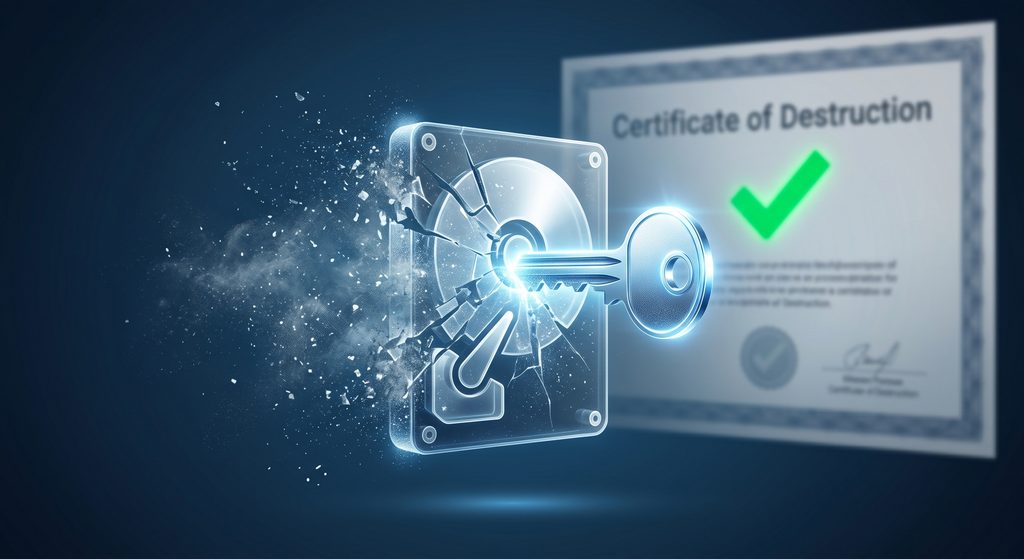
Once a matter has been officially closed, the retention period has expired, and the file has cleared automated checks to ensure no active litigation holds are in place, the data must be definitively disposed of. However, in the context of legal liability and OCG compliance, simply pressing “delete” is entirely inadequate.
Standard operating system deletion merely removes the directory pointer to the file, instructing the system that the space is available for future use. The actual binary data remains completely intact on the storage media and is easily recoverable using basic, consumer-grade forensic tools63. To satisfy regulatory requirements, client OCGs, and FRCP 37(e) defensibility, law firms must execute verified data sanitization26.
The NIST SP 800-88 Framework
The accepted global standard for data sanitization is the National Institute of Standards and Technology (NIST) Special Publication 800-88, Guidelines for Media Sanitization63. NIST 800-88 categorizes sanitization into three progressive levels, tailored to the sensitivity of the data and the physical nature of the storage media63:
- Clear (Logical Overwrite): Defends against standard recovery software by overwriting all user-accessible storage locations with a single pass of zeros or random data63. This is suitable for low-risk, internal, non-confidential files63.
- Purge (Cryptographic Erasure and Advanced Overwrite): Designed to protect against sophisticated, laboratory-level forensic attacks67. For modern Solid State Drives (SSDs), NVMe drives, and cloud environments where physical overwrite is technically impossible or unreliable due to wear-leveling algorithms, NIST mandates Cryptographic Erasure (CE)64.
- Destroy (Physical Destruction): Renders the media permanently and physically unusable. This involves industrial shredding or pulverization of physical hard drives, legacy floppy disks, and DLT tapes to particles smaller than 2mm, making data reconstruction physically impossible65.
The Mechanism of Cryptographic Erasure (CE)
For law firms managing petabytes of data in cloud document management systems or encrypted on-premises storage arrays, Cryptographic Erasure (CE) is the most vital mechanism for executing matter closure. Instead of attempting to overwrite the data itself, a process that takes hours and is often ineffective on SSDs, CE targets the encryption key protecting the drive or the specific cloud database.
When the firm’s retention policy engine dictates that a matter must be destroyed, an automated API call instructs the storage controller to permanently destroy or cryptographically regenerate the Media Encryption Key (MEK)68. Without the original key, the ciphertext left behind on the storage array becomes permanently and mathematically indecipherable. This process executes in seconds, scales effortlessly across massive cloud environments, and provides certainty that the data is gone.
Crucially, modern information governance systems automatically generate a tamper-proof Certificate of Destruction following a successful CE operation. This certificate includes the exact timestamp, the hardware serial number, the specific CE method used, the user authorization, and the scope of the data erased28. When a corporate client or a regulatory body audits the law firm to verify compliance with OCGs, this immutable audit trail serves as absolute, defensible proof that the firm has fulfilled its obligations regarding data privacy and destruction.
Conclusion: Take Control of Your Dark Data with Automated Intelligent Solutions
The legal industry’s historically asymmetric approach to the matter lifecycle, characterized by meticulous, risk-averse client intake and a chaotic, virtually non-existent approach to matter closure, can no longer be sustained. The era of exporting entire network drives to unstructured shares, hoarding unindexed DLT tapes, and hiding behind the ambiguity of 8.3 naming conventions has saddled law firms with petabytes of toxic dark data.
Today, this legacy data is not a strategic asset; it is an immense liability. Sophisticated cybercriminals target law firms precisely because they aggregate the most sensitive corporate data across the global economy. Furthermore, the combined pressures of global privacy regulations, stringent Outside Counsel Guidelines, and aggressive federal regulatory scrutiny demand that law firms take definitive action to protect, and ultimately dispose of, client information.
You do not have to tackle this massive operational burden alone. Automated Intelligent Solutions, Inc. specializes in delivering security assessments, workflow automations, and AI tools customized specifically for the modern law firm. We design and deliver Microsoft-native operations platforms built on robust security, compliance, and repeatable best practices that eliminate the guesswork of information governance.
By partnering with us, you can systematically dismantle the threat of spoliation while vastly reducing your attack surface through:
- Microsoft Environment Assessments: A structured assessment of your Microsoft 365, Entra ID, and SharePoint environment to generate a customized Readiness Score and actionable remediation priorities.
- Security & Compliance Hardening: We implement identity governance, conditional access, data loss prevention, and strict retention policies configured to meet your ethical obligations and Outside Counsel Guidelines.
- AI-Enhanced Workflows & Document Automation: We help you deploy safe, generative AI tools and matter management playbooks without compromising client data privacy.
Law firms that prioritize information governance and data minimization will not only mitigate catastrophic cyber and regulatory risks, but will unequivocally demonstrate their competency and commitment to protecting the absolute trust of their clients.
Stop letting dark data govern your risk exposure.
Visit us at https://automatedintelligentsolutions.com or contact our team directly at info@ais.email to learn more.
Ready to get started? Click here to book a consultation and secure your firm’s data today.
Works cited
- The Life Cycle of a Matter – 101 – ILTA, https://www.iltanet.org/blogs/maura-whelan/2017/02/17/the-life-cycle-of-a-matter-101
- The Life Cycle of a Matter – The Importance of Closing – ILTA, https://www.iltanet.org/blogs/alexander-campbell/2017/02/28/the-life-cycle-of-a-matter-the-importance-of-closing
- The Hidden Cascade: Why Law Firm Breaches … – Recorded Future, https://www.recordedfuture.com/blog/the-hidden-cascade
- The Legal and Regulatory Risk of Data Overretention – ISACA, https://www.isaca.org/resources/news-and-trends/industry-news/2025/the-legal-and-regulatory-risk-of-data-overretention
- Why Legal Teams Must Make Data Retention a Priority | Relativity Blog, https://www.relativity.com/blog/why-legal-teams-must-make-data-retention-a-priority/
- eDiscovery | CHAPTER 4: LEGAL HOLD (LITIGATION HOLD) – Exterro, https://www.exterro.com/basics-of-e-discovery/chapter-4-legal-hold-litigation-hold
- identification and remediation of dark data in law firms | Iron Mountain, https://resources.ironmountain.com/whitepapers/d/dark-data-task-force-report-identification-and-remediation-of-dark-data-in-law-firms
- Law Firm Document Management Problems: Why Firms Still Struggle, https://docsvault.com/blog/why-law-firms-struggle-with-document-management-7-common-problems/
- Dark Data in Law Firms: The Hidden Risk Lurking in Everyday Work, https://www.morae.com/insights/dark-data-in-law-firms-the-hidden-risk-lurking-in-everyday-work/
- Shefali Virkar, Peter Parycek, Noella Edelmann, Olivier Glassey, https://depts.washington.edu/egcdep18/documents/Virkar_et_al_2018.pdf
- The Growing Importance of Document Retention & Disposition in, https://www.futureintech.com/blog/from-neglected-to-necessary-the-growing-importance-of-document-retention-disposition-in-law-firms
- What is Data Classification & Why Is It Important? – Securiti.ai, https://securiti.ai/what-is-data-classification/
- Lock it Down: Cybersecurity Essentials for Small Law Practice, https://www.wisbar.org/wssfc/2025/Documents/Thursday/1TH_PM1_Cybersecurity.pdf
- Why data minimisation should be a hot topic for law firms – Legal-RM, https://legal-rm.com/whitepaper/why-data-minimisation-should-be-a-hot-topic-for-law-firms
- Law firm data retention – they can’t hack what you no longer have, https://www.informationbytes.com/2018/10/law-firm-data-retention-cant-hack-no-longer/
- Law Firm Data Breach Statistics 2026: Legal Data Risk – DeepStrike, https://deepstrike.io/blog/law-firm-data-breach-statistics
- When the Breach Hits the Docket: How Law Firms Should Respond, https://mblawfirm.com/insights/when-the-breach-hits-the-docket-how-law-firms-should-respond-when-client-files-leak-to-the-dark-web/
- Duane Morris Class Action Review, https://blogs.duanemorris.com/classactiondefense/category/duane-morris-class-action-review/
- Client Confidentiality as Data Security, https://scholarship.law.georgetown.edu/cgi/viewcontent.cgi?article=3691&context=facpub
- Current Developments in SEC Enforcement for Public Companies, https://www.morganlewis.com/-/media/files/publication/morgan-lewis-title/white-paper/2023/2023-current-developments-in-sec-enforcement-for-public-companies.pdf?rev=-1&hash=57F877D4CB91F7D391D873E73ACCCBE7
- Mutiny for a Bounty – UC Law SF Scholarship Repository, https://repository.uclawsf.edu/cgi/viewcontent.cgi?article=3102&context=faculty_scholarship
- Legal Document Management for Law Firms | GRM, https://www.grmdocumentmanagement.com/blog/legal-document-management/
- Common Mistakes When Maintaining a Client File, https://www.sfbar.org/blog/common-mistakes-when-maintaining-a-client-file/
- Ethics Opinion RI-392 – State Bar of Michigan, https://www.michbar.org/opinions/ethics/numbered_opinions/RI-392
- Whose File Is It? The Ethics of Returning a Client’s File and Property, https://www.bressler.com/publication-Whose-File-Is-It-The-Ethics-of-Returning-a-Clients-File-and-Property
- Law Firm Vendor Risk Management Guide – ELMIDA Solutions, https://www.elmidasolutions.com/blog/law-firm-vendor-risk-management-guide
- Cyber Risk Management: The Vital Role of Legal Management, https://www.alanet.org/legal-management/2019/october/features/cyber-risk-management-the-vital-role-of-legal-management-professionals
- SafeConsole USB Certified Data Erasure | NIST 800-88 – DataLocker, https://datalocker.com/safeconsole-platform/usb-certified-data-erasure/
- Post-Litigation Data Destruction & Defensible Archiving, https://discoverytechlab.com/post-litigation-data-destruction-archiving/
- Rational Enterprise: eDiscovery and Information Governance Software, https://www.rationalenterprise.com/
- Spoliation: When the Duty to Preserve Data Outweighs the, https://www.troutman.com/insights/spoliation-when-the-duty-to-preserve-data-outweighs-the-obligation-to-delete/
- Master Class – Retain, or destroy (data)? That is the question! – ILTA, https://www.iltanet.org/events/event-description?CalendarEventKey=188f0b2a-ea4e-4bad-a1a2-9aa9f392ebc3&Home=%2Flive-events%2Fcalendar
- The difference between routine document destruction and spoliation, https://www.contractorsperspective.com/claims-and-disputes/document-destruction-and-spoliation/
- Reasonable Preservation Process under FRCP Rule 37(e) | PDF, https://www.slideshare.net/slideshow/ediscovery-infographic-reasonable-preservation-process-under-frcp-rule-37e/73738553
- Handling Sensitive Client Data in a Forensic Collection Without, https://www.khflaw.com/news/handling-sensitive-client-data-in-a-forensic-collection-without-risking-spoliation/
- Sedona Conference Has Created New Principles on Defensible, http://idm.net.au/index.php/article/0012134-sedona-conference-has-created-new-principles-defensible-disposition
- aka ‘The Orange Rag’ – Legal IT Insider, https://legaltechnology.com/wp-content/uploads/2021/10/insider316.pdf
- How Long Should You Retain Corrective Action Records? | Simple, https://sbnsoftware.com/blog/how-long-should-you-retain-corrective-action-records/
- when the firm moves: Keeping or destroying old documents – Dentons, https://www.dentons.com/en/~/media/6b4e783192c34a978345eeb30be0b98f.ashx
- Defensible deletion: No spoliation where defendant destroyed, https://www.technologylawsource.com/2013/10/articles/privacy-1/defensible-deletion-no-spoliation-where-defendant-destroyed-emails-and-documents-pursuant-to-its-records-retention-policies/
- Law Firm Document Retention and Legal Holds Guide – CaseDocker, https://www.casedocker.com/landing/resources/guides/law-firm-document-retention-and-legal-holds-guide
- Records Management | Legaltech Hub, https://www.legaltechnologyhub.com/topics/law-firm-operations/records-management/
- Matter Advantage | Controlled data. Confident legal work., https://www.matteradvantage.com/
- Closing Files in a Law Firm: Best Practices to Protect Attorneys and, https://www.walkeradvertising.com/closing-files/
- 7 Data Issues Law Firms Don’t See And How to Fix Them – Helm360, https://helm360.com/data-issues-law-firms-miss-and-how-to-fix-them/
- Ethics Opinion 283 – DC Bar, https://www.dcbar.org/for-lawyers/legal-ethics/ethics-opinions-210-present/ethics-opinion-283
- eDiscovery Cost: Pricing, Budget Guide & Cost Calculator, https://trustarray.com/en-us/insights/articles/breaking-down-ediscovery-costs-what-law-firms-wish-theyd-asked-upfront
- AI in legal businesses: Use cases, solution, benefits and, https://www.leewayhertz.com/ai-use-cases-in-legal-businesses/
- AWS Marketplace: Securiti, https://aws.amazon.com/marketplace/pp/prodview-yg7xd2hfsul3y
- Best Data Security Platforms Reviews 2026 | Gartner Peer Insights, https://www.gartner.com/reviews/market/data-security-platforms
- Use Cases – Legal Workflow Automation Scenarios | ReVia | ReVia, https://www.revia.ai/use-cases
- RAG Security: Vector & Embedding Weaknesses | OWASP LLM08, https://www.a10networks.com/glossary/rag-security/
- SoK: Privacy Risks and Mitigations in Retrieval-Augmented … – arXiv, https://arxiv.org/html/2601.03979v1
- Data Governance for Retrieval-Augmented Generation (RAG), https://enterprise-knowledge.com/data-governance-for-retrieval-augmented-generation-rag/
- Secure Enterprise RAG: Vector DB and LLMOps, https://petronellatech.com/blog/securing-enterprise-rag-governance-vector-db-security-llmops-for-compliant-genai/
- LLM08:2025 Vector and Embedding Weaknesses, https://genai.owasp.org/llmrisk/llm082025-vector-and-embedding-weaknesses/
- IT Support & Cybersecurity for Law Firms – intSignal, https://www.intsignal.com/industries/legal
- AI Document Editor for Legal Teams | Vespper, https://www.vespper.com/use-cases/legal/ai-document-editor-for-legal-teams
- Four Hats, One AI: Building, Investing In, and Practicing Law … – Attri, https://attri.ai/blogs/four-hats-one-ai
- AI Governance for Law Firms: Protecting Client Data (2026) – LeanLaw, https://www.leanlaw.co/blog/what-are-the-data-privacy-implications-of-using-ai-tools-with-confidential-client-information/
- BigID + Windows Weekly, https://home.bigid.com/windows
- RAG Detailed Guide: Data Quality, Evaluation, And Governance, https://www.digitaldividedata.com/blog/rag-detailed-guide-data-quality-evaluation-and-governance
- NIST SP 800-88 Data Destruction – Your Complete 2025 Guide to, https://www.ambeteco.com/article/Offigneum/nist-sp-800-88-data-destruction-your-complete-2025-guide-to-nist
- Data Sanitization Standards: NIST, ADISA & DoD Explained, https://www.human-i-t.org/understanding-data-sanitization-standards/
- What is ISO 27001 Data Destruction? Clauses and Controls, https://www.centraleyes.com/glossary/iso-27001-data-destruction/
- SP 800-88 Rev. 2, Guidelines for Media Sanitization – NIST CSRC, https://csrc.nist.gov/pubs/sp/800/88/r2/final
- NIST 800-88 Data Destruction Guide – CyberCrunch, https://ccrcyber.com/nist-800-88-data-destruction
- Cryptographic Erase Explained: What NIST SP 800-88 Requires, https://dsecuretech.com/blog/cryptographic-erase