

Consider a hypothetical 85-employee IT reseller and managed-services firm that has skipped federal bids because its revenue sits above familiar small-business limits. The SBA’s proposed overhaul could create openings for that firm in one classification, while creating a fresh problem in another: the proposed removal of the IT value-added reseller exception. That is the real story for government contractors. The proposal may broaden eligibility, but it also makes a casual, company-wide answer to “Are we small?” much less useful. Your firm needs an eligibility map, built code by code and bid by bid.
- Why expansion creates a classification problem first
- Build an eligibility map around the right metrics
- Audit exceptions and reassess the competition
- Turn the proposal into a bid-readiness workflow
- Frequently asked questions
- What smart contractors should do now
Why expansion creates a classification problem first
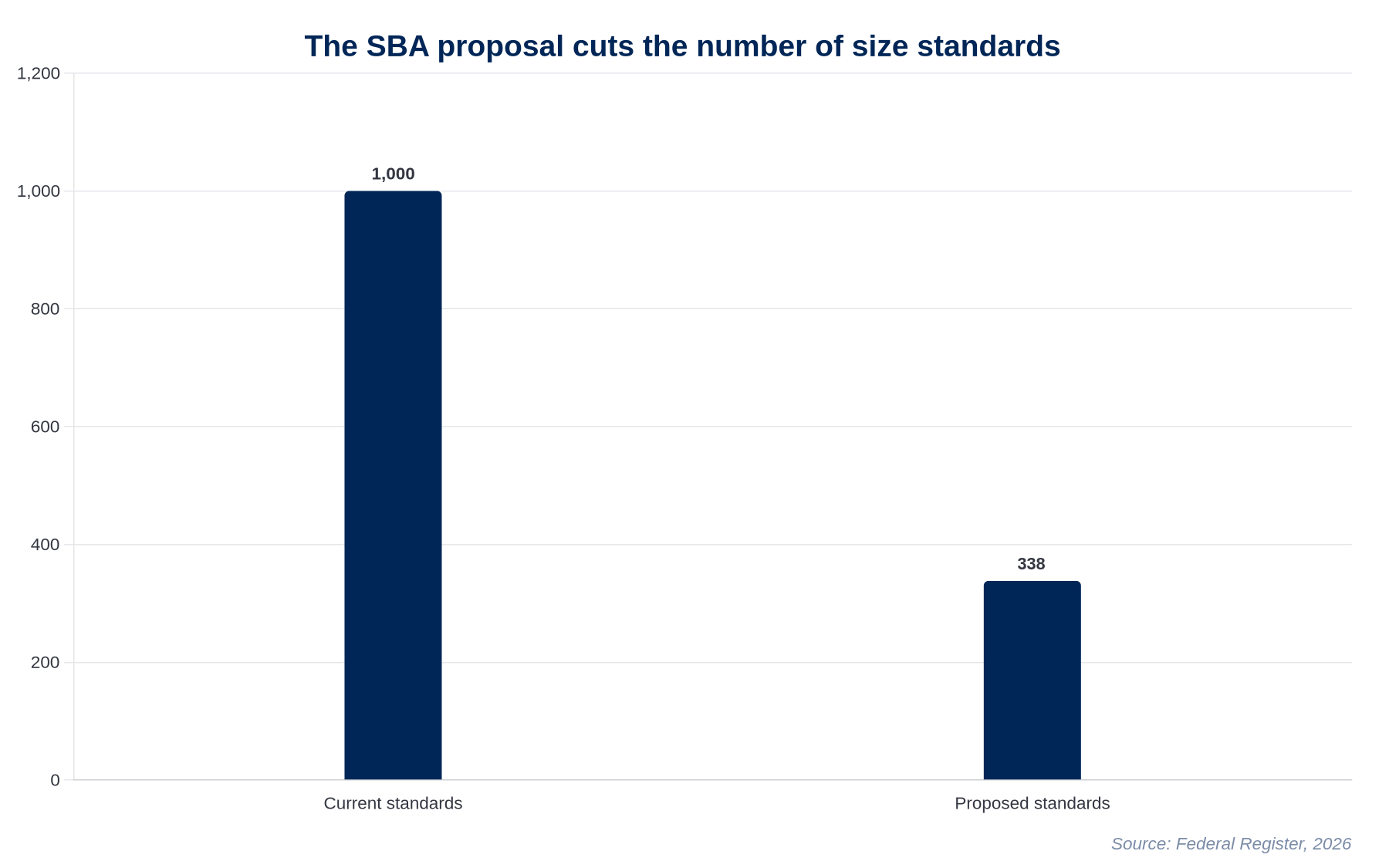
The SBA proposal would replace nearly 1,000 industry-specific size standards with 338 standards at the four- and five-digit NAICS levels, while excluding NAICS 4911, NAICS 5211, NAICS 8141 and Sector 92 from the new standards. The agency says the revised approach is meant to consolidate the standards and change how covered industries are classified. That sounds simpler. For an operations team, the transition is still a mapping exercise.
SBA has framed the change as a way to simplify classification and expand access to federal programs, according to the agency’s own announcement. Both outcomes may follow. Yet a broader category can create a new administrative burden if your firm sells different services, bids under multiple codes or has built its pursuit process around a familiar receipts ceiling.
Take the 85-person IT reseller and managed-services firm from the opening. Its first task is not to announce that it can pursue more set-asides. It should list its actual offerings, the NAICS codes used in past solicitations, the classifications attached to active opportunities and the standard proposed for each. That exercise may show that managed services, systems design and product resale need separate treatment. The change is practical: its capture team stops using one revenue figure as a blanket stop sign and starts asking which classification governs the work being pursued.
Most firms will get this wrong by treating the proposal as a sales headline. Eligibility is not a marketing label. It is a controlled decision tied to the work, the solicitation and the applicable standard. A firm that can explain its internal logic will move faster and make fewer avoidable certification mistakes.
Build an eligibility map around the right metrics
The proposed overhaul changes more than the number of classifications. Where it has discretion for industries that are neither manufacturing nor services, SBA proposes employee-based standards by default, reducing receipts-based standards from 496 to 129. That means a company that has watched annual revenue closely may need a much more disciplined employee-count record for future bid decisions.
The proposed methodology would also remove explicit maximum caps, with minimum thresholds of 500 employees for employee-based standards and $30.6 million in annual receipts for receipts-based standards, according to an analysis from Crowell & Moring. Separately, SBA proposed a much heavier emphasis on employee measures where it has discretion. That combination is why neither headcount nor receipts should be treated as an afterthought.
What belongs in the register
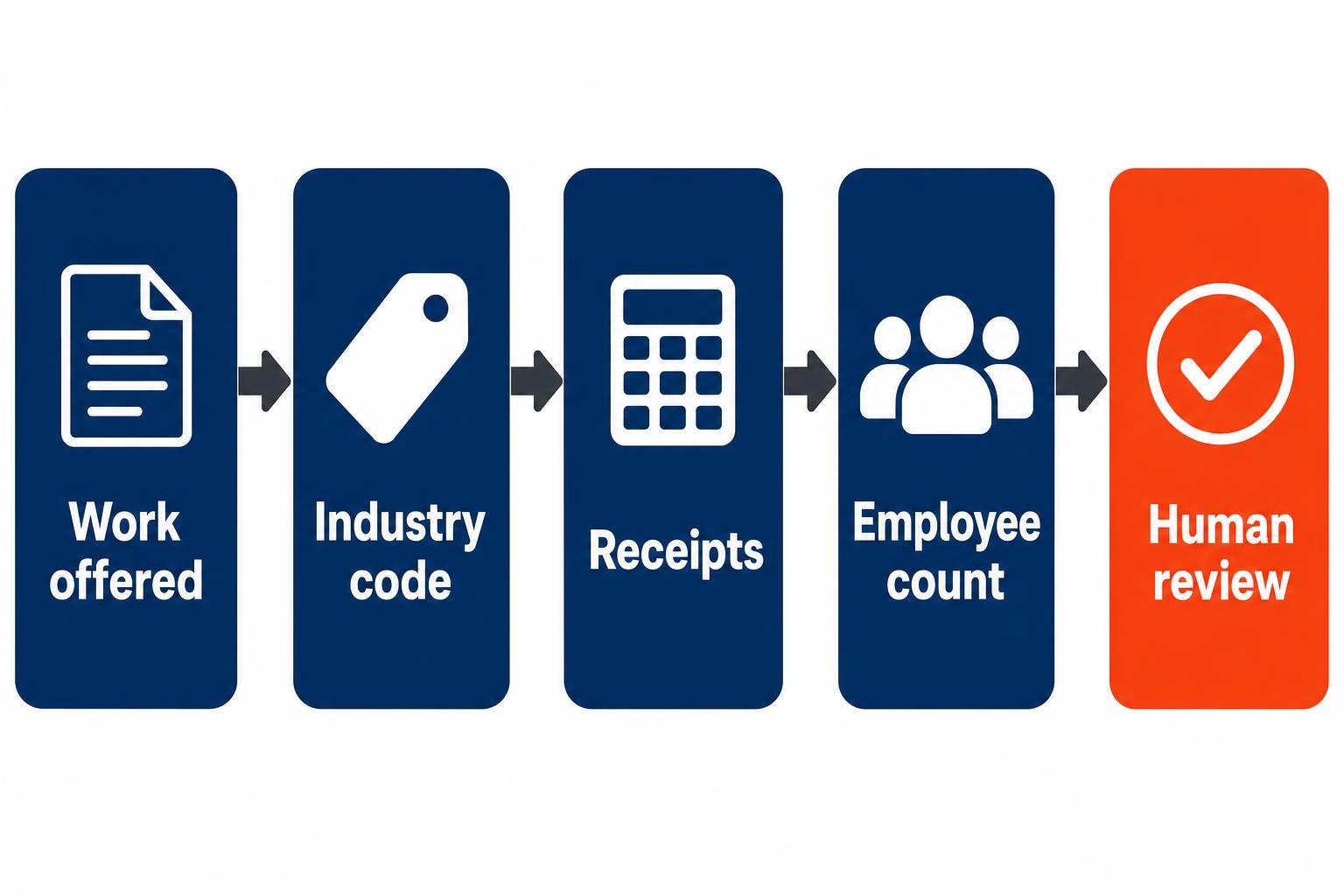
Build one controlled register for every current and target bid category. A spreadsheet can work at first, but the fields need an owner, a refresh date and a review trail. At minimum, record:
- the service or product being offered and the likely NAICS code;
- the current standard and proposed treatment to be monitored;
- the receipts measure used in your internal review;
- employee-count data and the date it was confirmed;
- any exception your team has historically relied on;
- active solicitation deadlines, decision owner and escalation notes.
Consider a hypothetical 60-person construction subcontractor that has historically screened opportunities through a receipts-first process. Under the proposal, construction and several other sectors could move from receipts-based to employee-based standards where SBA has statutory discretion. The firm’s operations manager should pull its staffing data, reconcile regular and project hiring records, then identify bids where the governing test may change. What changes is the conversation: the estimator no longer rejects an opportunity on revenue alone, and the final determination goes to a qualified reviewer with the right facts assembled.
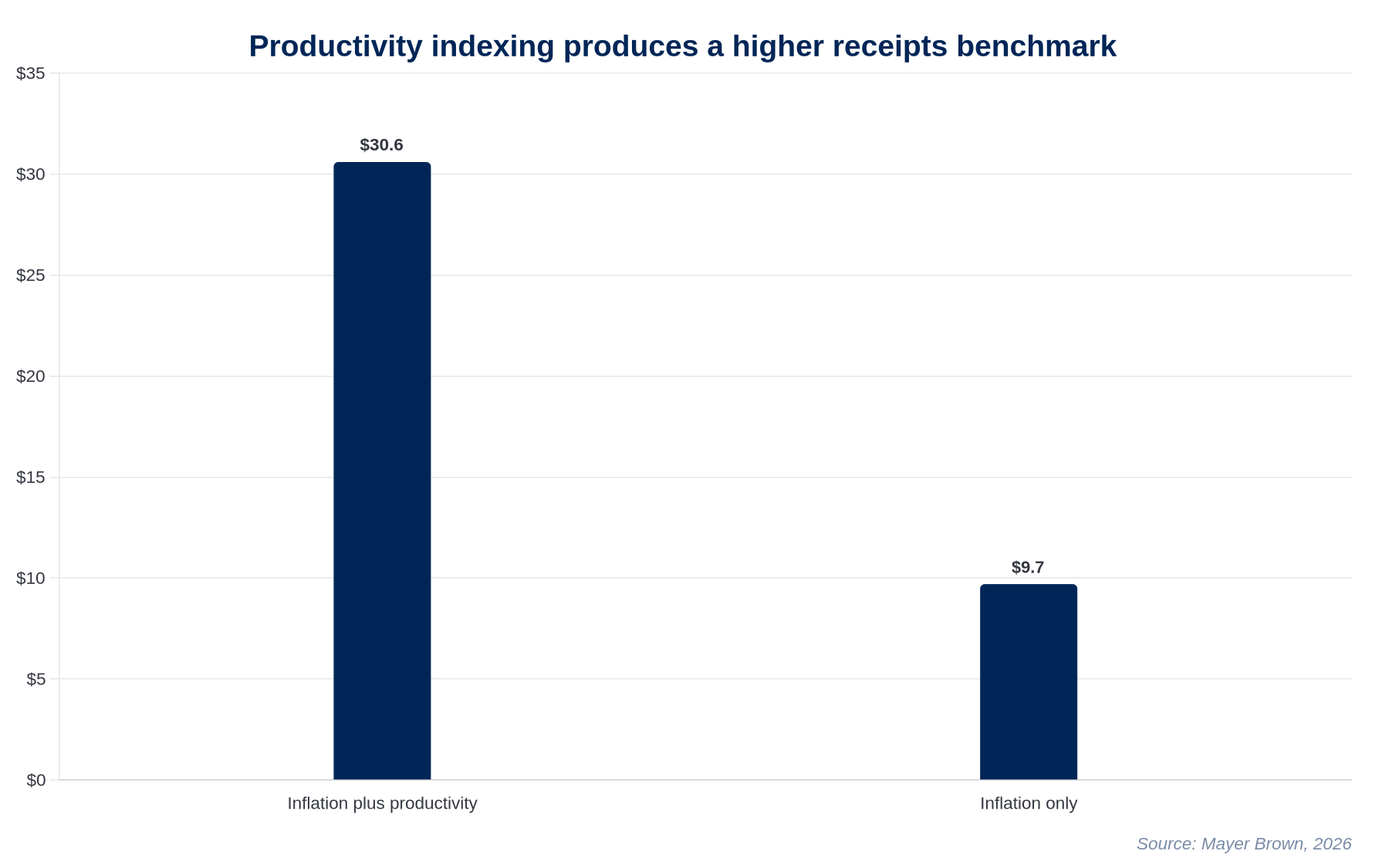
Receipts still matter where they remain the measure. SBA proposed adjusting receipts-based standards for productivity growth as well as inflation. For the methodology’s historical $1 million benchmark, the proposal illustrates a $30.6 million result under productivity-plus-inflation indexing, compared with $9.7 million under inflation-only indexing. That is a significant methodological choice, not a bookkeeping footnote.
Audit exceptions and reassess the competition
Expansion does not move every company in the same direction. SBA has proposed eliminating all current subindustry size-standard exceptions, including the information-technology value-added reseller exception, according to an analysis from Schwabe. For a reseller that has organized its qualification analysis around that exception, a larger general threshold elsewhere does not automatically offset its removal. The exception itself belongs in the register, marked for specific review.
Return to the 85-employee IT firm. It should create separate rows for resale activity, managed services and systems-design work. Then it should flag every opportunity where the old reseller exception shaped a pursuit decision. The output is not a yes-or-no answer generated by software. It is a short queue of decisions for the person who understands the solicitation, the actual work and the applicable rules.
There is another side to the opportunity. In computer systems design and related services, the proposal would raise the standard to $531 million in annual receipts, compared with current standards ranging from $34 million to $37 million. Your firm may newly fit within a category, but much larger rivals may fit there too. Bid strategy should therefore ask two questions: Can we compete for this work as small, and who else may enter the pool if the rule takes effect?
This is where small contractors can outperform larger organizations. A big company may have more analysts, yet a disciplined small firm can update its target-account list, teaming approach and price strategy quickly when each classification has a clear owner. Eligibility is a gate. It is not a win strategy.
Turn the proposal into a bid-readiness workflow
The comment period on the revised methodology proposal closed on September 21, 2026. That means the useful operational move now is to monitor the rulemaking while building a repeatable internal process. Waiting for the final outcome before organizing the data will leave your team rushing when a relevant solicitation appears.
For a small firm already using Microsoft 365, start with a shared list as the eligibility register, assign a business owner to each NAICS category and use Power BI to show entries approaching a refresh date. A workflow tool can prompt the owner when a new solicitation is logged, when employee data needs confirmation or when a proposal deadline is nearing. This is the sort of focused operational use case described in 7 Benefits of Process Automation for Small Business Owners.

AI can help summarize a solicitation, extract candidate classifications and highlight fields that appear incomplete. It should not make the final size-status determination. Treat it like a junior analyst that prepares a review packet, not an authority that certifies eligibility. The discipline is similar to the advice in Your First AI Agent Should Have One Small Job: define a narrow task, retain oversight and test the output before expanding its role.
Keep the final approval manual. A designated executive, contracts lead, counsel or experienced SBA adviser should review any classification with an exception, ambiguous scope of work, incomplete data or a material bid decision. Automation should make that review better prepared, not make it disappear.
Frequently asked questions
Is the SBA small business size standards overhaul final?
Do not treat a proposed rule as an operating assumption for a bid. The SBA’s deadline to comment on the revised methodology was September 21, 2026, which has passed, but your firm should monitor subsequent official action and have a qualified reviewer confirm the applicable standard before making a certification decision.
Will my business qualify as small under the proposed SBA rules?
Possibly, but a company-wide answer is often too broad. Review the work you are bidding, its NAICS code, the proposed measurement type and your current supporting records. A firm may see a different result across service lines, especially when one opportunity uses receipts and another calls for an employee-based review.
What should an IT reseller do if the value-added reseller exception goes away?
Do not carry a specialized exception into future planning automatically. Create separate records for resale, managed services and systems-design activity, then identify every target bid affected by the old assumption. Escalate ambiguous cases for a human determination, and use the review to reassess both qualification and competitive positioning.
Can AI determine whether my company meets an SBA size standard?
AI can prepare useful review material by summarizing solicitations, organizing records and flagging missing fields. It should not make the final determination. Size status can turn on classification, scope and records that need accountable human judgment. Use AI to reduce administrative work, then retain a documented approval step.
What smart contractors should do now
The proposed SBA size standards overhaul may widen the field for many small firms, but it also changes the discipline required to compete. For the 85-employee IT reseller, the next move is not a broad claim of new eligibility. It is a code-by-code map of services, receipts, headcount, exceptions and target solicitations. Build that register now, assign ownership and keep the final decision with an accountable human reviewer. Firms that organize the evidence before the rulemaking outcome is clear will be better prepared to act when opportunity arrives.
This article is general information for business owners, not legal, tax or financial advice. Rules vary by state and change often; confirm current requirements with a licensed professional before acting.
Ready to explore how you can streamline your processes? Reach out to Automated Intelligent Solutions today for expert guidance and tailored strategies.