
A 22-person accounting firm reaches review season with managers reconstructing 12 months of performance from memory, inbox searches, and a few utilization reports. Employees receive ratings, yet nobody can clearly name which feedback, priorities, or strengths should shape the next quarter. That is the familiar annual review failure: the meeting becomes a verdict on an employee when it should test whether the firm’s management system produced useful evidence all year. Better annual performance reviews start with five questions that expose gaps in feedback, goals, recognition, and follow-through before those gaps cost productivity.
- What evidence, not recollection, supports this review?
- Did the employee receive feedback soon enough to use it?
- Which strengths created measurable business value?
- What manager behavior helped or hindered performance?
- How can Microsoft 365 create evidence without surveillance?
- What will be different by the next check-in?
- Frequently asked questions
1. What evidence, not recollection, supports this review?
An annual review built from memory rewards visibility, recency, and the manager’s personal impressions. It can miss the employee who quietly resolved difficult client issues in March, trained a colleague in June, or flagged a costly process problem before it spread. The first question is therefore simple: what record exists of work completed, feedback given, barriers raised, and commitments kept?
The need for a record is not bureaucratic fussiness. In a Workhuman iQ survey, only 21% of workers reported meeting at least weekly with their manager for a one-to-one check-in, while workers who never met one-to-one were more than three times as likely to be highly disengaged. When regular conversations are absent, a year-end meeting has little dependable material to work with.
Ask managers to bring three categories of evidence: outcomes, observed behaviors, and obstacles. Outcomes might include a completed client deliverable, fewer rework cycles, or a project completed to an agreed standard. Behaviors are the repeatable actions behind those results, such as clear client updates or careful handoffs. Obstacles reveal where management, staffing, systems, or unclear priorities held the person back.

Consider the accounting firm in the opening scenario. Rather than asking a tax manager, “How did Sarah do this year?”, the managing partner asks: “Which client files improved because of Sarah’s work? What feedback did she receive when the work was happening? What recurring issue did she raise, and what did we do about it?” The review shifts from a personality judgment to an operational examination. It may reveal that Sarah’s strongest contribution was catching missing client information early, while the firm failed to give her a consistent escalation path.
That distinction matters because employees who receive weekly manager check-ins are 3.5 times more likely to be engaged than those receiving feedback only during annual reviews. Your review form should make missing evidence visible. A blank section is not a reason to speculate. It is a management-system defect to fix.
2. Did the employee receive feedback soon enough to use it?
Most small firms do not need more meetings for their own sake. They need feedback close enough to the work that an employee can change course, repeat a good practice, or ask for help before a client deadline turns a small issue into a costly one.
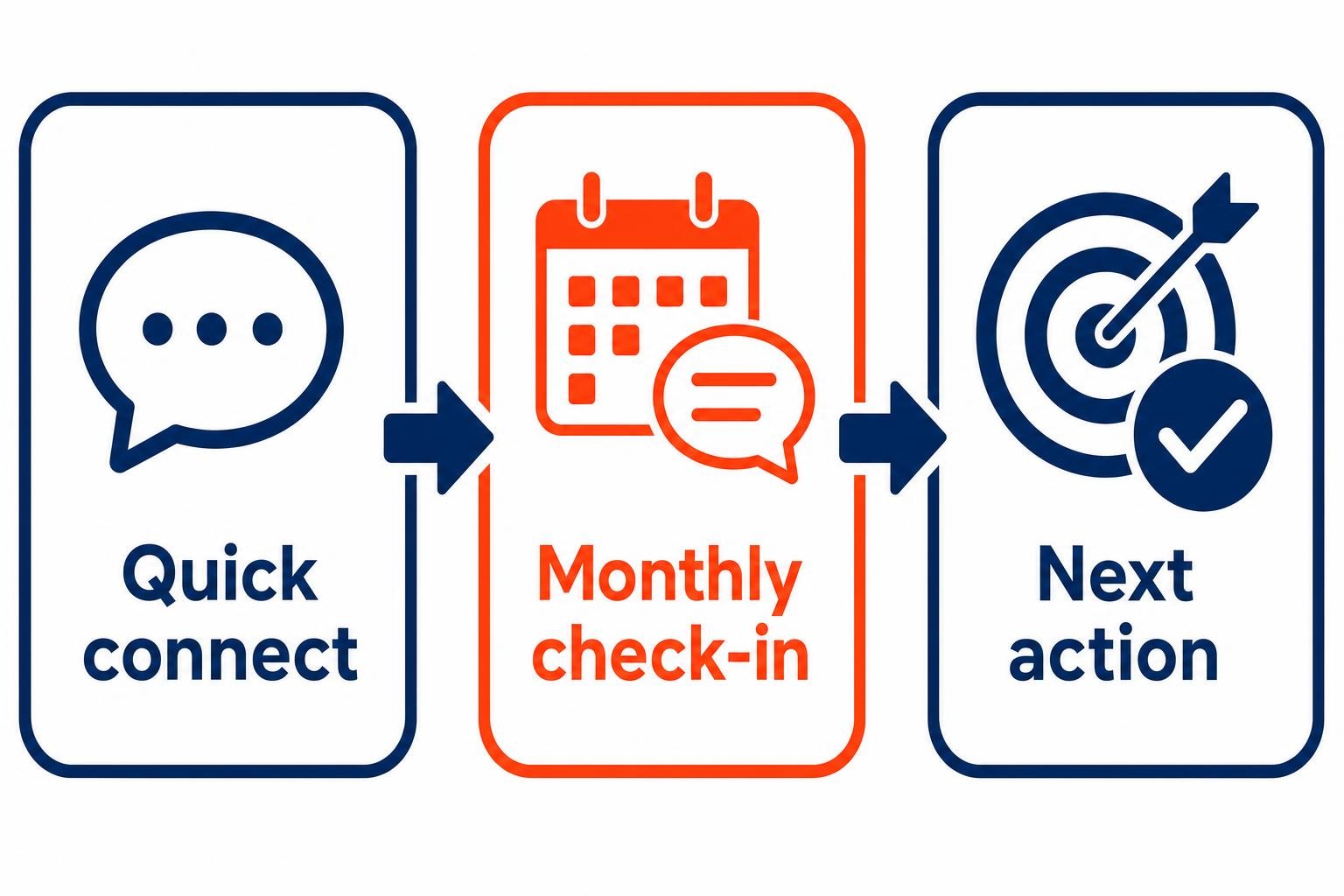
Use two rhythms. A quick weekly connection can cover immediate priorities, blockers, recognition, and a single request for support. A deeper monthly conversation can look at workload, development, client patterns, and progress against larger goals. Gallup recommends a meaningful weekly conversation of 15 to 30 minutes that includes goals, customers, wellbeing, and recognition. That is a useful guide, not a license to fill calendars with status meetings.
Quality is the test. Gallup reports that 80% of employees who received meaningful feedback in the previous week were fully engaged. “Meaningful” means specific enough to act on. “Good job” after a client presentation is pleasant. “Your early summary gave the client a decision they could make quickly, so use that structure on the renewal proposal” is feedback with a next move.
At the review, ask the employee to identify one piece of feedback that changed their work. If neither party can name one, do not paper over the gap with a generic development goal. Agree on when feedback will happen, what kind of work deserves discussion, and how the manager will show follow-through.
3. Which strengths created measurable business value?
Annual performance reviews often spend too much time cataloging deficiencies. Small firms cannot afford that habit. You need to know which individual strengths produced better client outcomes, faster throughput, fewer errors, stronger sales conversations, or calmer delivery under pressure. Then assign work and development opportunities accordingly.
A strengths question is not flattery. It requires a chain of evidence: name the strength, identify where it appeared, and connect it to a business result. For example, “You are detail-oriented” is vague. “Your ability to spot incomplete engagement letters reduced last-minute questions before client onboarding” identifies an observable contribution and points to work the person should continue doing.
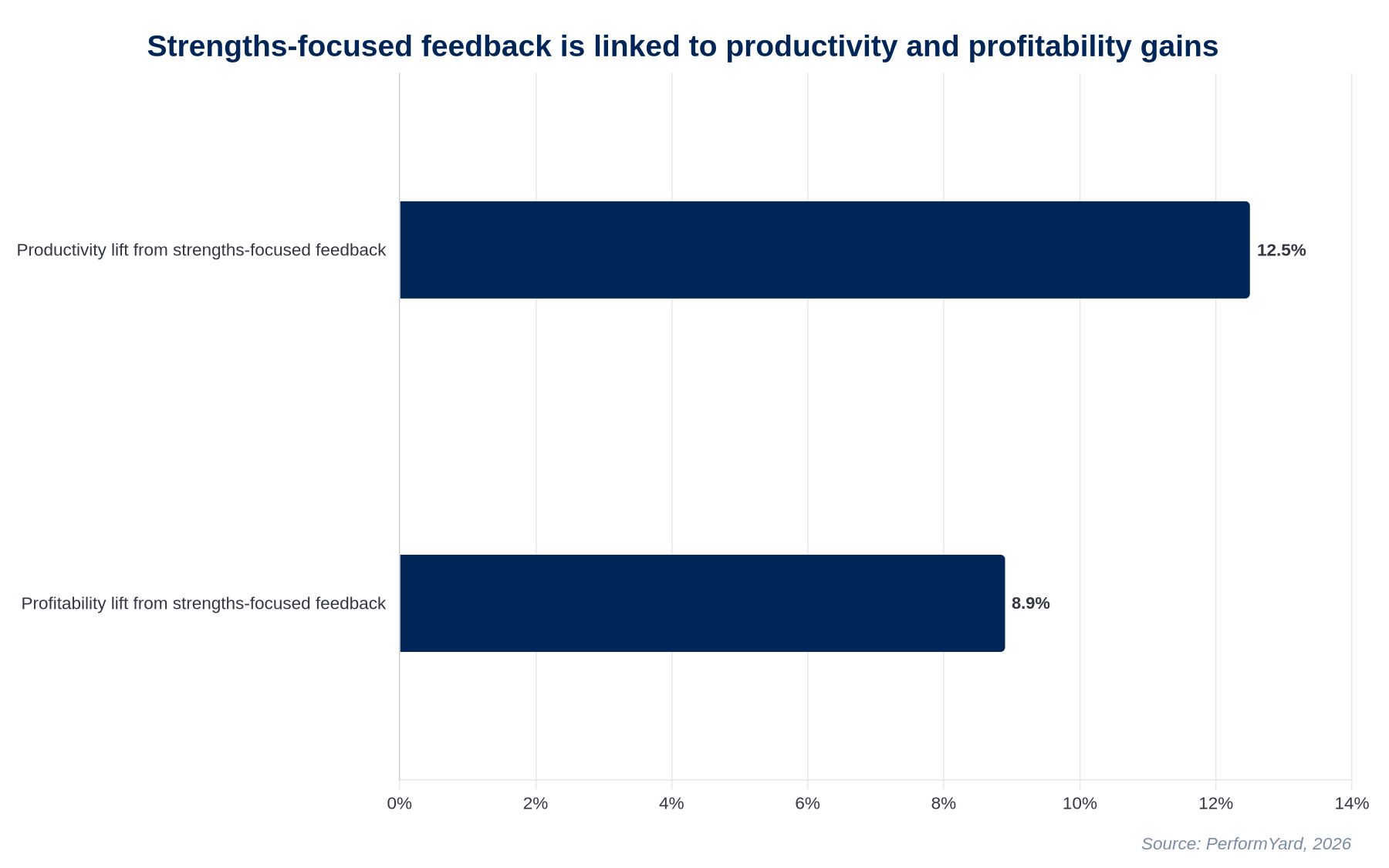
There is a business case for this focus. Teams that emphasize employee strengths in feedback are reported to have 12.5% higher productivity and 8.9% greater profitability on average than teams that do not. Gallup’s Q12 meta-analysis also links employee engagement statistically with productivity measures, including revenue or sales per person, production volume, and performance ratings.
Take a hypothetical 10-person engineering consultancy. A project coordinator receives middling comments for not being technically specialized. Yet the evidence shows she consistently anticipates client questions, turns scattered decisions into clear action lists, and prevents consultants from duplicating work. Her manager changes the next-quarter plan: she leads project kickoff documentation, receives training in account coordination, and is paired with a senior consultant on client handoffs. The review becomes an allocation decision, not a list of traits to admire.
Do not ignore gaps in performance. Put them in context. If a gap is a skills issue, define the practice opportunity. If it is a recurring process failure, own the process failure. If it is a mismatch between the person’s strengths and assigned work, change the work where feasible.
4. What manager behavior helped or hindered performance?
An employee’s review should include an honest examination of the manager. Did the manager set priorities when work collided? Did they recognize useful behavior while it could be repeated? Did they remove blockers? Did they keep promises made in earlier conversations? A rating process that treats management as invisible invites the same problems next year.
Weekly one-to-ones of roughly 30 minutes are rated as the most desirable cadence and linked to the highest engagement in a synthesis of meeting-science research reported by Newman Human Resources Consulting. Still, meeting frequency is not the whole standard. An employee can attend every meeting and leave with no clearer priorities, no decision, and no support.
Include a short manager self-review alongside the employee review. It should ask what feedback was delivered, what commitments were completed, where decisions were delayed, and what the manager will change. Research summarized in the International Journal of Advanced Research in Science, Communication and Technology associates regular coaching conversations with approximately 14.9% higher employee productivity. The direction is plain: coaching should be treated as operating work, not a soft extra performed when deadlines permit.
Use Microsoft 365 to preserve the evidence, not police people
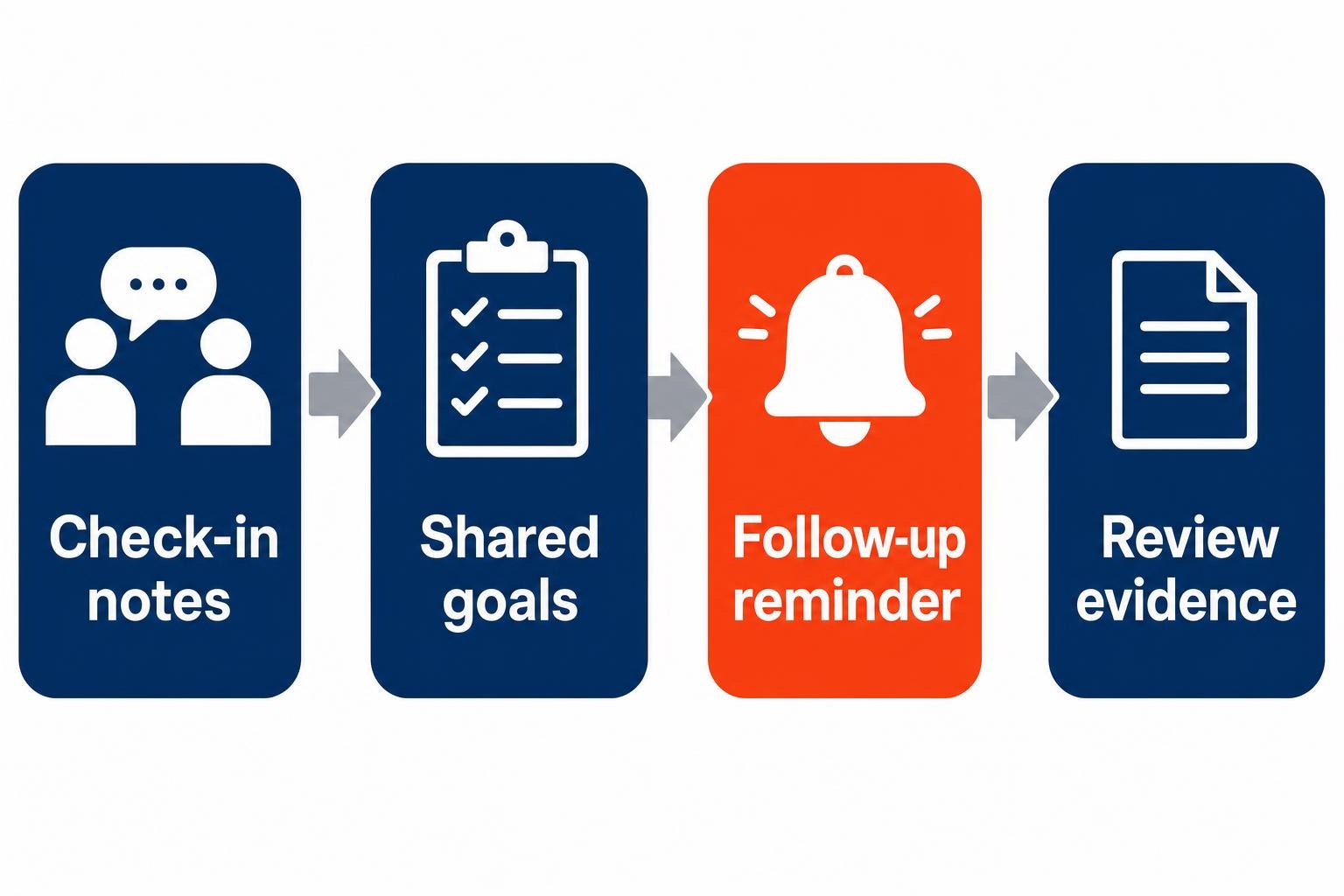
The practical technology goal is a lightweight evidence trail. Start with a shared OneNote agenda for each manager and employee, with four repeating prompts: progress, obstacles, feedback, and next action. Use Teams check-in templates for brief weekly conversations, Planner goals for visible commitments, and Power Automate reminders when an agreed follow-up date arrives.
The important design choice is consent and restraint. These records should capture agreed outcomes and useful context, not create a diary of every keystroke or casual comment. Employees should be able to see the notes relevant to their review, correct material errors, and know what information will be carried forward. Keep private personnel judgments in the appropriate restricted process, not in a broadly shared workspace.
AI has a narrow, helpful role here. With employee-approved notes, it can summarize recurring blockers, group completed commitments, or draft a review outline for the manager to verify. It should not assign ratings, infer attitude, or make a judgment about potential. Managers retain context, accountability, and the obligation to have the actual conversation. For a sensible scope, start where your first AI agent has one small job, rather than handing it an opaque role in performance management.
This approach also depends on orderly calendars and clear ownership. A firm that has not separated protected focus time, client commitments, and internal coordination will struggle to maintain a useful cadence. The discipline behind three calendar lanes for a small business makes recurring manager conversations much easier to protect.
5. What will be different by the next check-in, not next year?
End every annual review with a short operating agreement. It should fit on one page and contain four items:
- One priority the employee will advance before the next substantive conversation.
- One support commitment the manager will deliver, such as a decision, introduction, resource, or coaching session.
- One behavior worth recognizing when it appears again.
- A scheduled follow-up with a clear agenda.
This is where the accounting firm can repair its problem. The manager and employee may agree that the employee will document missing client information at intake, while the manager will decide within two business days whether a client escalation is needed. The next check-in tests whether both parties did what they said, rather than waiting for another year to judge the result.
Research summarized by Evalflow distinguishes short weekly quick connects from deeper monthly conversations and emphasizes that quality and follow-through matter more than sheer meeting volume once regular contact is established. Put the annual review in service of that rhythm. It should launch the next useful conversation, not conclude the only one.
Frequently asked questions
How often should a small business conduct employee performance reviews?
Most small firms should keep an annual review for reflection, development, and documentation, while using regular conversations to manage the work itself. A weekly quick connection and a deeper monthly conversation can create the evidence an annual review needs. The right cadence is one your managers can maintain with clear follow-through.
What should managers bring to an annual performance review?
Managers should bring documented outcomes, examples of observed work behavior, feedback already given, goals or commitments from earlier conversations, and unresolved blockers. They should also bring a self-assessment of their own support and follow-through. This produces a more credible conversation than relying on recent events, inbox searches, or general impressions.
Can AI write employee performance reviews for a small business?
AI can help summarize approved check-in notes, organize goals, and identify recurring topics for a manager to examine. It should not determine ratings, infer intent, or replace the manager’s judgment. A manager needs to verify every draft, add context, discuss it directly with the employee, and remain accountable for the final review.
What makes performance feedback useful?
Useful feedback is specific, timely, connected to real work, and followed by a clear next action. It names what happened, why it mattered, and what should be repeated or changed. Employees also need room to explain blockers or competing priorities, because some performance problems are caused by unclear direction or weak systems.
Make the annual review a test of the system
The best annual performance review asks whether your firm created the conditions for good work to be seen, discussed, and repeated. Evidence beats recollection. Timely feedback beats retrospective surprise. Strengths should inform assignments, while managers should be accountable for the clarity and support they provide. For the 22-person accounting firm, the next review season should not begin with inbox archaeology. Begin now with a simple check-in record, one visible goal, and one follow-up promise. Then use the annual conversation to improve the management system that produced the year’s work.
Ready to explore how you can streamline your processes? Reach out to Automated Intelligent Solutions today for expert guidance and tailored strategies.